Fact-checked and reviewed by Kshitij Shah (BitNine), Chartered Accountant.
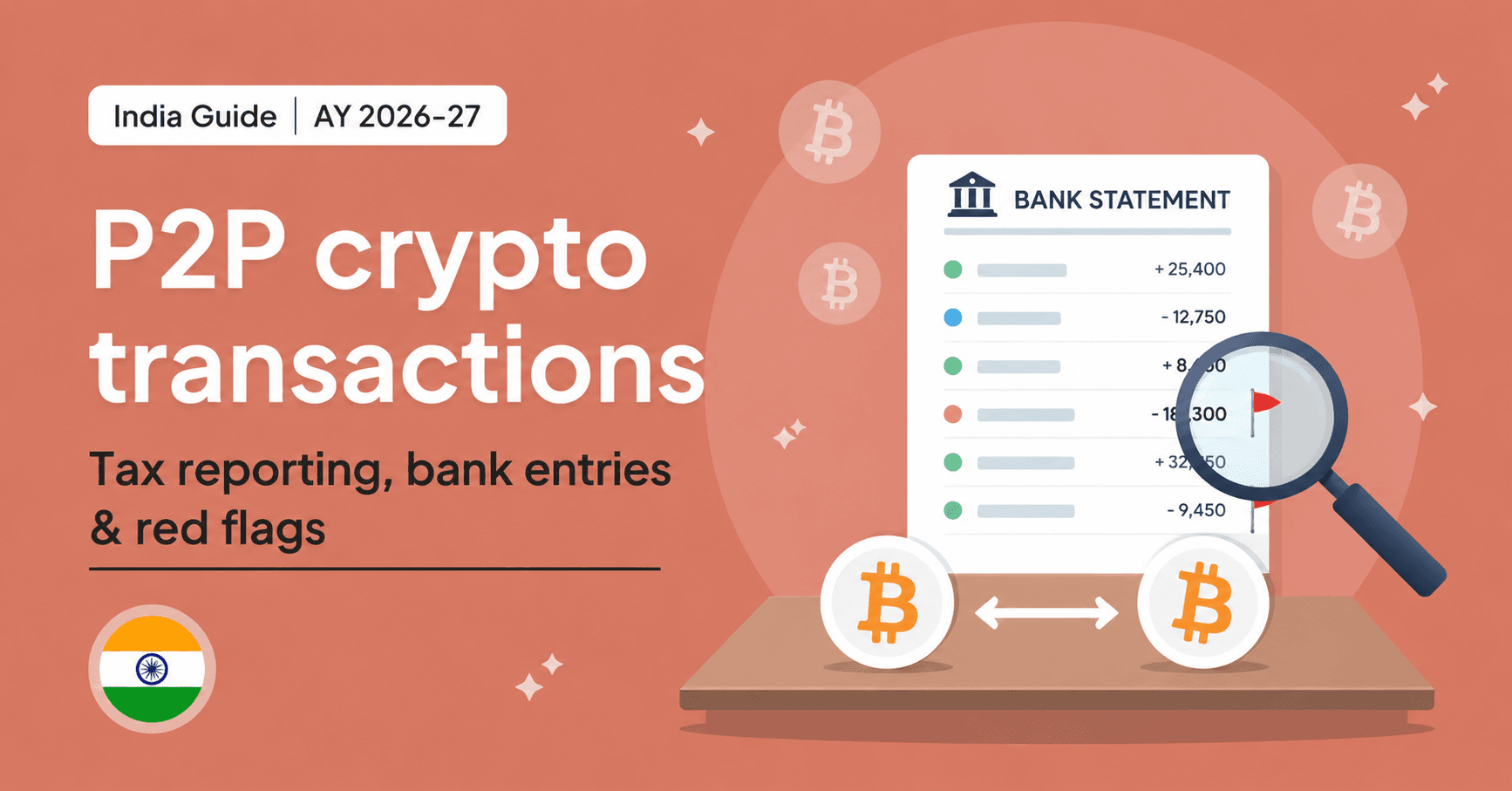
P2P crypto transactions create a different reporting problem from ordinary exchange trades. The tax rule on the VDA transfer does not disappear, but the payment trail often looks messier because money moves directly through bank accounts between users instead of through a clean exchange settlement ledger. That is why P2P files tend to break at the reconciliation stage. The return may show one number, the bank statement may show another pattern, and Form 26AS or AIS may show only part of the picture.
The core rule still starts with the VDA framework. For AY 2026–27, VDA income is disclosed transaction-wise in Schedule VDA in ITR-2 and ITR-3, while the correct ITR form depends on whether the taxpayer has business income. So the real issue with P2P trades is not whether they are taxable. It is how to disclose them cleanly when the payment trail, TDS trail, and bank trail do not always line up automatically.
Key takeaways
- P2P crypto trades are still VDA transfers for Indian tax purposes, so the normal Schedule VDA disclosure question does not go away just because the trade happened user-to-user.
- Circular No. 14 of 2022 says that in a peer-to-peer buyer-to-seller transaction without going through an exchange, the buyer is required to deduct tax under section 194S. It also says Form 26Q is used generally and Form 26QE is available for specified persons, meaning individuals or HUFs not liable for tax audit.
- The same circular says the threshold relief under section 194S applies where consideration paid by a specified person does not exceed ₹50,000 in the financial year, or ₹10,000 for others.
- AIS is broader than Form 26AS and allows taxpayer feedback, showing both reported value and modified value after feedback.
- The Department’s defective-return and e-proceedings FAQs say problems can arise where TDS credit is claimed but corresponding receipts are omitted, or where gross receipts in Form 26AS are higher than total receipts shown in the return.
- If your crypto activity is on business account, section 44AA books-of-account obligations may also matter because business taxpayers must keep books and documents that enable income computation.
Table of contents |
No credit card required
Why P2P trades create more filing friction
A normal exchange trade usually leaves one recognizable reporting trail. A P2P trade often leaves several. There may be an order record on the platform, a direct bank transfer between counterparties, and a separate VDA transfer or release. That makes the tax file more vulnerable to mismatch, especially if the taxpayer later reports only net profit without preserving the bank-side evidence that explains how the transaction actually moved. This is a practical inference from the Schedule VDA framework, the AIS system, and the Department’s mismatch guidance.
This is also why P2P traders often get anxious about bank entries. The entry itself is not the tax rule. The problem is what the entry looks like when it is not matched to a clear VDA trade history. If the return, bank statement, and tax-credit trail tell different stories, the file starts to look incomplete even when the taxpayer believes the tax paid is broadly correct.
What section 194S says about direct buyer-to-seller trades
This is the most important official rule for true direct P2P trades. Circular No. 14 of 2022 says that in a peer-to-peer transaction, meaning buyer to seller without going through an exchange, the buyer is required to deduct tax under section 194S. The circular also explains that the deduction applies at the time of credit or payment, whichever is earlier, and that the deducted tax must be deposited and reported through the prescribed TDS process.
The same circular also gives the threshold relief. No deduction is required where the consideration is payable by a specified person and does not exceed ₹50,000 in the financial year, or where it is payable by a person other than a specified person and does not exceed ₹10,000 in the financial year. Here, specified persons generally means individuals or HUFs not liable for tax audit. The circular further says Form 26Q is used generally and Form 26QE has been introduced for such specified persons.
This matters because many taxpayers assume P2P means off-record. The circular says otherwise for direct buyer-to-seller transactions. It does not mean every platform-assisted trade works identically, but it does mean genuine P2P VDA transfers cannot be treated as invisible merely because they happened outside a standard domestic exchange settlement flow.
Why bank entries become tax red flags
The red flags are usually not about one bank transfer by itself. They arise when the bank trail, the TDS trail, and the return trail do not reconcile.
A practical way to read the main risk points is this:
| Situation | What usually goes wrong | What to check first |
| Bank credit received for a P2P sale but no matching Schedule VDA disclosure | The money trail exists, but the VDA disclosure is incomplete | Match the bank entry to the order ID, quantity sold, and Schedule VDA row |
| Section 194S credit is claimed but the receipt side is missing or understated | TDS appears in Form 26AS, but the related receipts are not properly shown | Compare Form 26AS with Schedule VDA and your bank ledger |
| Multiple third-party bank entries from P2P trades look unstructured | The bank statement does not clearly explain which trade each entry belongs to | Rebuild trade-by-trade mapping with payment proof |
| AIS shows information that does not match your own records | The portal reflects source-reported data differently from your books | Review AIS entry type and submit feedback where justified |
The Department’s own FAQs already tell you what the portal is checking. The e-proceedings and defective-return guidance say issues arise where TDS credit is claimed without offering corresponding receipts or where gross receipts in Form 26AS are higher than the receipts shown in the return. AIS also allows taxpayer feedback and shows both reported and modified values. So from a tax perspective, the real “red flag” is inconsistency.
A simple example makes this easier to see. Suppose you sell USDT through a direct P2P transaction and the buyer pays you ₹3 lakh into your bank account. If section 194S was deducted or otherwise forms part of the reporting trail, but your return later reflects only a net figure without a clear transaction-level VDA disclosure, the file can start to look incomplete. The issue is not that ₹3 lakh must equal taxable profit. The issue is that the bank entry, TDS trail, and Schedule VDA trail must tell a coherent story.
Where P2P trades belong in your ITR
The return form still depends on the broader character of your income. For AY 2026–27, ITR-2 is for individuals and HUFs not having income from profits and gains of business or profession, while ITR-3 is for individuals and HUFs who do have business or professional income. The Department’s FAQ separately says Schedule VDA is used in both ITR-2 and ITR-3 to disclose VDA income transaction-wise.
So the filing sequence is usually:
- first decide whether the overall crypto activity is on capital account or business account
- then choose ITR-2 or ITR-3 accordingly
- then disclose the P2P VDA transactions properly in Schedule VDA
- then make sure any section 194S trail and bank trail can be matched back to those disclosures
If the P2P activity is being carried on as a business, books of account also become more important. Section 44AA says business taxpayers must keep and maintain books and documents that enable the Assessing Officer to compute income in accordance with the Act. That does not create a separate P2P tax rule, but it does make poor recordkeeping more dangerous once the activity is business-like.
The records that make a P2P file defensible
For P2P traders, documentation usually matters more than extra explanation. If the file is clean, the reporting becomes much easier. If the file is weak, the taxpayer ends up trying to explain a bank statement after the fact.
The most useful records are:
- platform order IDs and trade confirmations
- bank statement entries with date, amount, and counterparty trail
- UTR or payment reference details
- screenshots or exports showing the VDA quantity and price
- any section 194S deduction proof, where applicable
- transaction-wise Schedule VDA working papers
- if the activity is business-like, books and summaries that satisfy section 44AA expectations
That list is not directly lifted from one P2P circular. It is the practical result of combining section 194S rules, Schedule VDA disclosure, AIS feedback mechanisms, mismatch guidance, and books-of-account obligations. In short, a P2P file needs a clearer evidence trail because the bank-side movement is usually more visible than the tax logic unless the taxpayer documents both together.
How cryptact helps
P2P crypto tax problems usually begin as reconciliation problems. A trader may know the broad tax rule, but the filing still breaks because the bank entries, platform records, TDS trail, and Schedule VDA disclosures were never tied together trade by trade.
That is where cryptact helps in a practical way. It brings transaction records into one place, makes the P2P trail easier to review, and helps separate gross receipt evidence from final tax computation. For taxpayers using Binance P2P, USDT trades, or other user-to-user settlement flows, the biggest value is often not just calculation. It is being able to explain why the bank statement, Form 26AS, AIS, and the return all connect properly.
Conclusion
A clean P2P crypto reporting file in India starts with one discipline: do not treat the bank entry as separate from the tax entry. In direct buyer-to-seller VDA trades, section 194S can apply to the buyer, Schedule VDA still matters, and the bank-side payment trail can create visibility even where the platform trail is less tidy. The tax problem is usually not the existence of one transfer. It is the mismatch between the payment trail and the reporting trail.
That is why the safest workflow is transaction first, return second. Identify the exact trade, match the bank credit or debit to the VDA movement, check whether any section 194S trail exists, and only then finalize the ITR disclosure. That is also where cryptact adds real value. It helps turn scattered P2P records into a usable reporting file, so the return is easier to prepare and much easier to defend if the tax department later asks questions.