Fact-checked and reviewed by Kshitij Shah (BitNine), Chartered Accountant.
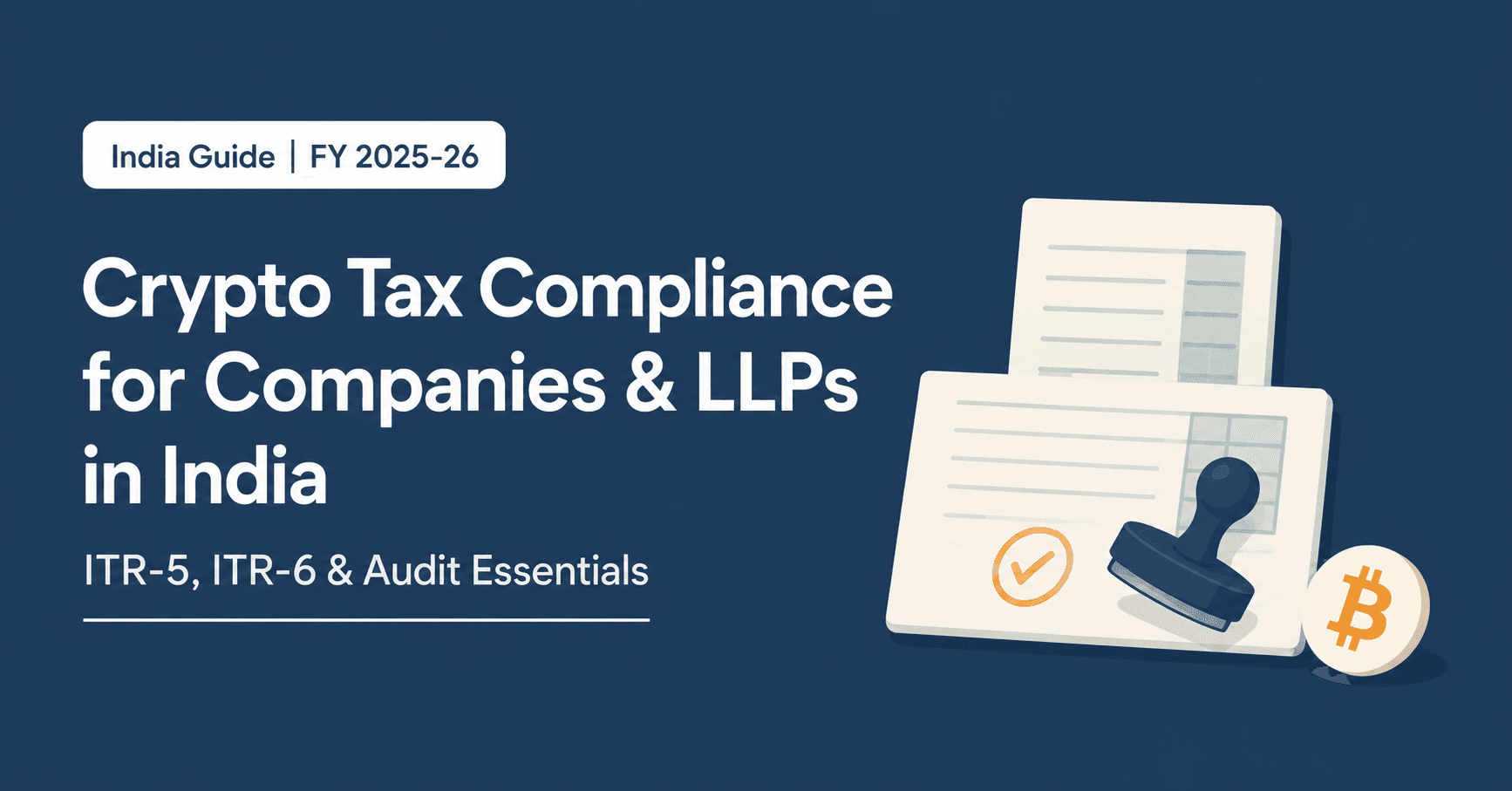
A company or LLP cannot file its crypto activity in the same way as an individual investor. The entity has its own books, profit and loss account, balance sheet, tax return, audit position, and TDS responsibilities. It may also earn crypto through several routes rather than simply buying and selling tokens.
A Web3 company might charge clients for development work, collect platform fees, operate validators, hold treasury tokens, pay vendors in VDAs, and trade part of its holdings. Each activity enters the accounts differently. Section 115BBH applies to income from transferring a VDA, but it does not automatically turn every receipt earned by a crypto business into 30% VDA transfer income.
The filing process starts by separating normal business revenue from VDA transfers. The entity must then reconcile those figures with its accounts, report every taxable transfer in Schedule VDA, and use the return form that matches its legal structure.
For AY 2026–27, LLPs generally file ITR-5. Companies generally file ITR-6 unless they claim an exemption under section 11. Both forms contain Schedule VDA and require transaction-level reporting.
Key takeaways
- Section 115BBH applies to companies and LLPs because it covers any assessee that earns income from transferring a VDA.
- An LLP generally files ITR-5, while a company generally files ITR-6 unless it falls within the section 11 exception.
- Business revenue received in crypto does not automatically become VDA transfer income. The entity must record the original revenue recognition, and Section 115BBH will apply only on subsequent disposals.
- Schedule VDA requires details of every taxable transfer, including acquisition date, transfer date, cost, consideration, and the head of income.
- Companies that trade or invest in crypto must provide specific crypto disclosures in their Schedule III financial statements.
- Statutory audit and tax audit are separate requirements. A company or LLP may need to satisfy both.
No credit card required
Why entity-level crypto reporting needs a separate approach
An individual may hold crypto as a personal investment. A company or LLP usually acquires and uses VDAs within a wider business structure.
The entity may receive tokens from customers, purchase assets for its treasury, collect network rewards, trade tokens, or use crypto to settle expenses. A single wallet can therefore contain several types of transactions with different accounting and tax consequences.
The legal owner also matters. Directors, founders, partners, and employees should not mix personal wallets with the entity’s assets. When a founder buys tokens personally and later transfers them to the company, the books need to show whether the company purchased the tokens, received a capital contribution, obtained a loan, or merely holds them on behalf of the founder.
The records should answer four basic questions:
- Who owns the wallet or exchange account?
- Why did the entity receive or transfer the VDA?
- What value did the entity recognise in Indian rupees?
- Did the transaction create operating income, an expense, an asset movement, or VDA transfer income?
Without those answers, the accountant may struggle to connect the blockchain history with the ledger and tax return.
How section 115BBH applies to companies and LLPs
Section 115BBH does not limit the 30% VDA tax regime to individuals. It applies where the total income of an assessee includes income from transferring a virtual digital asset. A company and an LLP both fall within that framework.
The section taxes positive income from a VDA transfer at 30%, plus the applicable surcharge and cess. It allows the cost of acquisition but blocks deductions for other expenditure while computing that transfer income.
It also blocks the set-off and carry-forward of a VDA transfer loss.
Suppose an LLP records the following trades:
- profit of ₹6 lakh from selling one token;
- loss of ₹2 lakh from selling another token; and
- exchange and advisory expenses of ₹60,000.
The LLP cannot reduce the ₹6 lakh positive transfer income by the ₹2 lakh VDA loss. It also cannot deduct the ₹60,000 while calculating the section 115BBH amount, apart from any expenditure that genuinely forms part of the permitted acquisition cost.
The accounts may still show the commercial loss and expenses. The tax return then makes the necessary adjustments to arrive at the amount taxable under section 115BBH.
Separating business revenue from VDA transfer income
A crypto company can earn normal business income even when the customer pays in tokens.
Consider an LLP that develops blockchain software and raises an invoice for ₹8 lakh. The client pays the invoice in ETH worth ₹8 lakh on the payment date.
The LLP should first recognise ₹8 lakh as revenue from its development services. The use of ETH as the payment method does not change the nature of that original receipt.
Assume the LLP later sells the ETH for ₹10 lakh. The later sale creates a separate VDA transfer. Subject to the valuation and cost records, the entity would generally examine the ₹2 lakh increase under section 115BBH.
The file should therefore preserve both stages:
- ₹8 lakh of operating revenue when the LLP receives the ETH for its services.
- ₹2 lakh of income from the later VDA transfer.
Combining the entire ₹10 lakh under Schedule VDA would ignore the original business receipt. Reporting only the ₹8 lakh service revenue would omit the later appreciation.
The same distinction can arise when a business receives tokens as:
- development or consulting fees;
- platform charges;
- commission;
- validator or network income;
- compensation from a commercial arrangement; or
- payment for licensing intellectual property.
The facts decide the original income treatment. A later sale or swap can then bring section 115BBH into the calculation.
A business that issues its own token may face additional questions about revenue recognition, contractual obligations, customer advances, and regulatory classification. That situation needs a separate review rather than a simple VDA trading entry.
Choosing between ITR-5 and ITR-6
The correct form follows the entity’s legal status.
| Entity | Return generally used | Main crypto-related areas |
| Limited Liability Partnership | ITR-5 | Business income, balance sheet, profit and loss account, Schedule VDA, TDS, audit details |
| Partnership firm | ITR-5 | Business income, partner details, Schedule VDA, books and audit information |
| Domestic company | ITR-6 | Company financials, Schedule VDA, tax adjustments, audit information and company tax schedules |
| Foreign company filing an Indian return | ITR-6 | Indian taxable income, permanent establishment or other filing details, VDA income where applicable |
| Company claiming exemption under section 11 | Not ITR-6 | Review the form applicable to the exempt entity |
An LLP should not use ITR-4. The simplified presumptive form excludes LLPs and also does not suit income chargeable at a special rate under section 115BBH.
A company should not choose the form based on the number of crypto transactions. Whether it completed ten transfers or ten thousand, its corporate status points to ITR-6.
The return must also agree with the financial statements. Turnover, revenue, expenses, VDA income, closing holdings, TDS credits, and audit information should not tell different stories across the books and ITR.
Connecting Schedule VDA with the profit and loss account
ITR-5 and ITR-6 both contain Schedule VDA. The schedule asks the entity to provide details of every VDA transfer rather than one consolidated annual gain.
For each transfer, the entity needs:
- the acquisition date;
- the transfer date;
- the applicable head of income;
- the cost of acquisition;
- the consideration received; and
- the positive income from the transfer.
Where a transaction creates a loss, Schedule VDA takes the income as nil. The entity cannot offset that loss against profitable VDA transfers in the schedule.
The profit and loss account may already include the proceeds, gain, loss, or expenses connected with the tokens. The business-income schedule then adjusts the book result so the return can calculate section 115BBH income under the special rule.
That adjustment matters because the accounts follow the applicable accounting framework, while the tax computation follows section 115BBH. Book profit and taxable VDA income do not have to match automatically.
For example, the accounts may deduct exchange charges, custody fees, software costs, employee costs, and professional fees. Those costs may remain legitimate business expenses for the entity’s wider operations. However, section 115BBH does not allow the entity to deduct them from the income calculated on a specific VDA transfer, except for the permitted cost of acquisition.
The accountant should map every VDA-related ledger to one of three categories:
- part of the permitted acquisition cost;
- a normal operating expense outside the VDA transfer calculation; or
- an amount that the tax computation must add back or exclude.
This mapping prevents the entity from claiming a deduction twice or losing a valid operating expense merely because the business works with crypto.
Keeping reliable crypto books and balance sheet records
A year-end exchange screenshot does not provide enough support for a company or LLP. The books need to show how the entity acquired, held, transferred, and valued each asset.
A useful VDA ledger should capture:
- token name and quantity;
- wallet or exchange account;
- acquisition date and source;
- INR value at acquisition;
- purpose of the receipt;
- counterparty details where available;
- transaction hash or exchange order ID;
- fees;
- date and value of any transfer;
- closing quantity; and
- the link to the corresponding accounting entry.
The entity should maintain separate records for its own wallets, customer assets, employee or founder wallets, and tokens that it holds as a custodian. A token that belongs to a customer should not appear as the company’s treasury asset merely because it passes through an address that the company controls.
Internal wallet transfers also need clear labels. Moving a token from the entity’s exchange account to its hardware wallet does not change beneficial ownership. Treating that movement as a sale can overstate revenue and create a false Schedule VDA entry.
At the reporting date, the balance sheet should agree with the token quantities that the wallets and exchanges actually hold. The accounting policy should explain how the entity classifies and measures those assets under the standards that apply to it.
The tax rule does not decide the accounting classification by itself. Calling an asset a VDA for section 115BBH does not automatically tell the accountant whether the balance sheet should present it as inventory or another type of asset. The entity’s business model, purpose, applicable standards, and auditor’s assessment shape that decision.
Financial statement disclosures for companies and LLPs
Companies and LLPs must record crypto transactions in INR using the exchange/platform rate prevailing at the time of the transaction. If the transaction involves foreign currency, the INR figure should be worked out using the official exchange or telegraphic transfer rate for that date. This ensures the books stay aligned with Schedule III and tax compliance requirements.
Companies must address the specific crypto disclosure requirement contained in Schedule III to the Companies Act.
Where a company trades or invests in cryptocurrency or virtual currency during the financial year, its financial statements must disclose:
- the profit or loss from those transactions;
- the amount of cryptocurrency or virtual currency held at the reporting date; and
- deposits or advances received from any person for trading or investing in cryptocurrency or virtual currency.
These notes sit alongside the ordinary balance sheet and profit and loss figures. They do not replace the transaction-level Schedule VDA reporting in ITR-6.
An LLP follows the LLP accounting and financial disclosure framework rather than filing company financial statements under Schedule III. It must still maintain proper books and prepare its Statement of Account and Solvency. Its records should support the crypto amounts shown in ITR-5 and any audit report.
Both structures need consistency. The closing VDA holdings in the ledger should connect with the year-end financial statements. The VDA profit reported in the accounts should also reconcile with Schedule VDA after the tax adjustments.
Tax audit and turnover questions
A statutory audit and a tax audit serve different purposes.
A company undergoes an audit under company law. An LLP may also require an audit under the LLP framework. Neither requirement automatically settles whether section 44AB applies.
For a business, Section 44AB generally applies once turnover or gross receipts exceed ₹1 crore. If crypto activity is treated as business income, then the gross value of crypto disposals must be included in turnover for determining audit eligibility. The law raises the threshold to ₹10 crore where cash receipts and cash payments each remain within the prescribed 5% limit.
A crypto business still needs to determine its turnover on a consistent and defensible basis. High transaction value does not always equal accounting turnover, and net trading profit does not automatically equal turnover either.
The entity should document:
- which activities generate operating turnover;
- how it calculates turnover from VDA trading;
- whether it acts as principal, agent, broker, or service provider;
- whether customer funds pass through its accounts; and
- how the calculation connects with the audited books.
Where another law already requires an audit, the entity generally uses Form 3CA with Form 3CD for the tax audit. Form 3CB with Form 3CD applies in cases that do not require an audit under another law.
The tax auditor will need a clean reconciliation between the ledger, financial statements, tax computation, and ITR schedules.
TDS responsibilities under section 194S
A company or LLP can have responsibilities on both sides of section 194S.
When the entity purchases a VDA from a resident seller and pays consideration, it may need to deduct 1% TDS. Companies and LLPs generally fall under the ₹10,000 annual threshold, rather than the higher threshold limit of Rs. 50,000 available to specified individuals or HUF payers.
An exchange may handle parts of the deduction process for platform trades, depending on the transaction structure. The entity should not assume that the exchange has covered every direct transfer, over-the-counter purchase, or token settlement.
When the company or LLP sells VDAs, buyers or exchanges may deduct section 194S tax from the consideration. The entity should reconcile those credits with:
- Form 26AS;
- AIS;
- exchange statements;
- sales ledgers; and
- Schedule VDA.
TDS does not represent the final tax on the transaction. It works as a tax credit. The entity should not reduce the sale consideration or VDA income merely to match the net amount that reached its bank or exchange account.
A filing sequence for Web3 businesses
A structured close avoids most year-end problems.
Start by obtaining exports from every exchange, wallet, custody account, payment processor, and protocol used during the financial year. Match internal transfers before calculating gains.
Next, classify each receipt and payment. Separate service revenue, token sales, treasury purchases, customer assets, vendor payments, rewards, capital contributions, loans, and transfers between the entity’s own wallets.
Post the accounting entries and reconcile the closing token quantities with the actual wallets. Resolve missing costs and unexplained balances before the audit begins.
Then complete the tax working:
- identify every VDA transfer;
- calculate the permitted acquisition cost;
- exclude VDA losses from set-off;
- separate section 115BBH income from normal business profit;
- reconcile section 194S credits and deductions;
- review the section 44AB position; and
- complete Schedule VDA in ITR-5 or ITR-6.
Finally, compare the return with the financial statements and audit report. A last-minute Schedule VDA total should not override the books without a clear reconciliation.
How cryptact helps
Entity-level crypto reporting often breaks when the accounting ledger and blockchain history develop separately. The finance team may have bank entries and invoices, while the exchange and wallet records sit across several exports.
cryptact helps bring the transaction history together. It can organise exchange trades, wallet movements, acquisitions, disposals, and missing-data issues before the accountant prepares the final books and tax schedules.
The entity still needs to classify its business receipts correctly and decide how each amount enters the accounts. Once the transaction history connects, the team can build a cleaner reconciliation between the VDA ledger, Schedule VDA, financial statements, and audit working papers.
Conclusion
Crypto tax filing for a company or LLP involves more than applying the 30% rate to an annual profit figure.
An LLP generally files ITR-5, while a company generally files ITR-6. Both forms require transaction-level Schedule VDA reporting. Section 115BBH applies to positive income from VDA transfers, but normal business income can still arise when the entity earns service fees, commission, or other revenue in crypto.
The books must preserve that distinction. They should also identify the legal owner of every wallet, support year-end holdings, reconcile TDS, and connect with the balance sheet and profit and loss account.
cryptact helps organise the underlying crypto history so the company, LLP, accountant, and auditor can work from the same transaction trail. A complete record makes it easier to prepare ITR-5 or ITR-6 without mixing operating revenue, treasury holdings, internal wallet movements, and taxable VDA transfers.