As cryptocurrency prices like Bitcoin increasingly make headlines alongside traditional stock and forex market data, more and more people are becoming curious about what cryptocurrency actually is and how it works.
This article provides a beginner-friendly explanation of the fundamentals of cryptocurrency, including how it differs from traditional money and the technology that makes it all possible.
Key takeaways
- Cryptocurrency is a digital asset that can be sent directly from one person to another over the internet, without banks or payment processors in between, and it works the same way across borders.
- Unlike e-money, which is fiat currency in digital form managed by a central operator, cryptocurrency is a separate class of asset that generally runs without any central authority.
- Blockchain, the technology behind it, is a distributed transaction ledger: transactions are bundled into blocks, linked together in chronological order, and every participating node holds a full copy.
- Consensus algorithms such as Proof of Work keep that ledger trustworthy. Rewriting it would require controlling more than half of the network, known as a 51% attack, which is economically irrational on large networks like Bitcoin.
- Wallets manage blockchain addresses so that everyday users can hold, send, and receive cryptocurrency, though a wallet is often limited to specific blockchains or services.
- As an investment, cryptocurrency is far more volatile and less regulated than stocks or real estate, but it is accessible to almost anyone, tradable 24/7, and typically low in transaction costs.
|
Table of contents |
No credit card required
What Is Cryptocurrency?
There are many different types of cryptocurrency, including Bitcoin and Ether, but what exactly is cryptocurrency and how does it differ from traditional fiat currency? Let's take a closer look.
Cryptocurrency Is a Digital Asset You Can Trade Over the Internet
In simple terms, cryptocurrency is a digital asset that anyone can easily trade over the internet.
With traditional fiat currencies (such as the US dollar or euro), sending money online requires the involvement of banks, payment processors, or other licensed financial institutions with specialized infrastructure.
Cryptocurrency, on the other hand, allows individuals to send funds directly to one another with nothing more than an internet connection.
Because cryptocurrency exists on the internet, it can be accessed from anywhere in the world. Sending crypto to someone across the room is just as easy as sending it to someone on the other side of the planet. This borderless nature is one of cryptocurrency's most significant features.
How Cryptocurrency Differs from E-Money
One common point of confusion is the difference between cryptocurrency and electronic money (e-money) services like mobile payment apps.
Both cryptocurrency and e-money are digital forms of "money," so they may seem similar at first glance. However, there is a fundamental difference.
E-money is backed by fiat currency. It is simply a convenient way to use traditional money in digital form. Cryptocurrency, by contrast, is an entirely separate class of digital asset with no direct backing by any fiat currency.
Another key difference is the presence of a central authority. E-money systems always have a central operator that manages the platform, whereas cryptocurrency networks generally do not require a central authority. Instead, they rely on sophisticated decentralized technology, where network participants (called nodes) cooperate to keep the system running.
It is worth noting that not all cryptocurrencies are fully decentralized. Some are operated in a more centralized manner by specific organizations. The point above is a general principle about how the technology works.
How Does Cryptocurrency Work?
The cryptocurrency ecosystem can be thought of as a massive, globally distributed network system. Without a central authority, how does it all stay running? Let's explore the three core mechanisms.
Cryptocurrency Runs on a Blockchain
Cryptocurrencies like Bitcoin use a technology called blockchain.
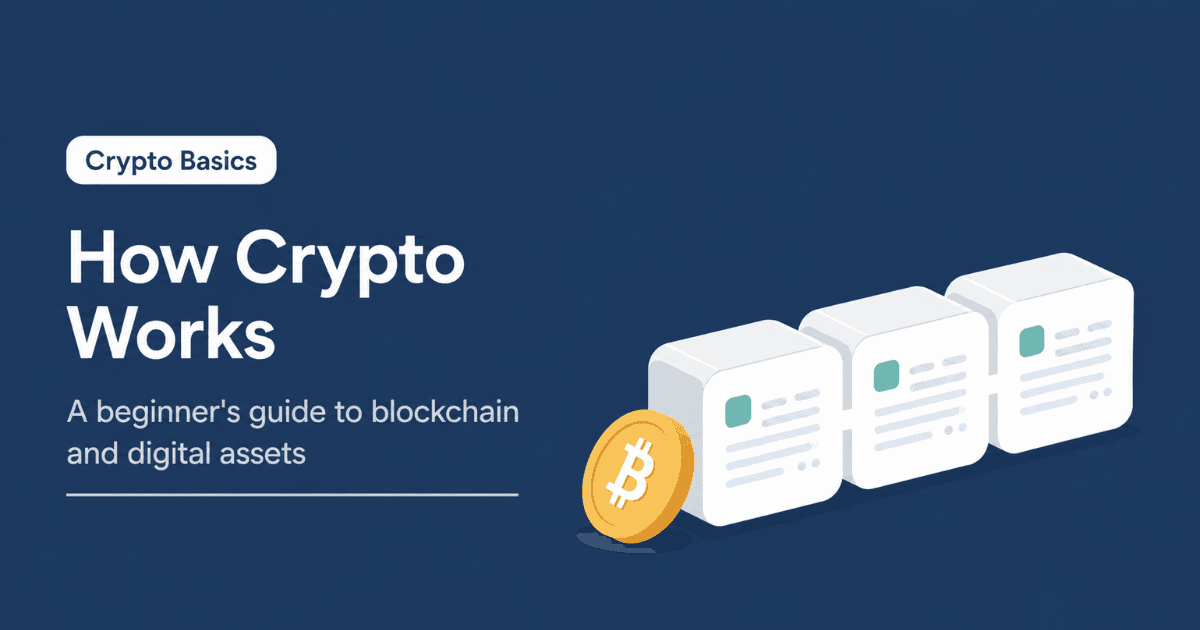
A blockchain is essentially a distributed transaction ledger maintained across the internet. Transaction data (called "transactions") is bundled into units called "blocks," and these blocks are linked together in chronological order like a chain, hence the name "blockchain."
One of the blockchain's most important features is that data does not reside on a single, centralized server. Instead, every participant in the network shares a copy of the ledger. These participants are called nodes, and each node holds a complete copy of the blockchain. When a new transaction occurs, the information propagates through the network, and new blocks are added to each node's copy.
This structure allows the entire blockchain network to function as one large, unified system.
Transactions Are Verified by Network Participants
As we discussed, each node on the blockchain holds its own copy of the transaction ledger and adds new transactions to it. But what prevents a bad actor from tampering with the ledger for personal gain?
Blockchains address this problem through mechanisms called consensus algorithms.
For example, Bitcoin uses a consensus algorithm known as Proof of Work (PoW). In this system, the right to create a new block is awarded to the node that first solves a complex cryptographic puzzle.
The puzzle involves finding a value called a nonce, and the problem itself is linked to the contents of both the previous block and the new block. The first node to solve the puzzle adds the new block to the chain and broadcasts the block along with the nonce to the rest of the network. Each receiving node verifies that the answer is consistent (i.e., the continuity between the old and new blocks is correct) before accepting the new block and passing it along.
This means that even if a malicious node tries to tamper with the ledger, other nodes will reject the fraudulent block, preventing it from being reflected across the blockchain.
To forcefully alter the blockchain, an attacker would need to control more than half of all nodes on the network. This is known as a 51% attack and is considered one of the theoretical risks to blockchain security. However, on large networks like Bitcoin, carrying out such an attack would require enormous computational resources, and the resulting damage to the network's credibility would cause prices to plummet, making it economically irrational.
Cryptocurrency Is Stored and Used via Wallets
So far we have looked at the technical side of how cryptocurrency works. Now let's explore the user experience.
While the blockchain is a distributed transaction ledger, interacting with it directly is not exactly user-friendly. That is where wallets come in.
A blockchain contains entities called addresses, and the transaction history reveals how much cryptocurrency is held at each address. A wallet manages these addresses, allowing you to think of your cryptocurrency holdings much like cash in a physical wallet.
Wallets also provide functions for sending cryptocurrency and generating receiving addresses. When you send crypto from your wallet, you are essentially creating and broadcasting a transaction on the blockchain.
Thanks to wallets, everyday users can hold, send, and receive cryptocurrency with ease.
Keep in mind that wallets are often limited to specific blockchains or specific services, so if you hold a variety of cryptocurrencies, you may need to use multiple wallets.
Pros and Cons of Cryptocurrency Investment
How does investing in cryptocurrency compare to traditional financial assets like stocks or real estate? Here is a quick overview:
| Cryptocurrency | Stocks | Real Estate | |
| Price volatility | Very high | Moderate | Low / gradual |
| Market maturity | Developing (regulations still evolving) | Mature (well-established rules) | Mature (tangible assets) |
| Track record | Short | Long | Very long |
| Liquidity | Tradable 24/7 | Generally liquid during market hours | Transactions take time |
| Transaction costs | Often low | Often low | Very high |
Cryptocurrency is still a relatively young asset class, and regulations continue to evolve. There are no government-backed deposit insurance schemes for crypto, making it a higher-risk investment. Markets can also be driven by news and whale (large investor) activity, leading to sharp price swings.
On the other hand, cryptocurrency is accessible to almost anyone, can be traded in very small amounts, and transaction costs tend to be low, making it an approachable option for newcomers to investing.
If you are interested in cryptocurrency, make sure to understand these pros and cons before making any investment decisions. Note that you may need to report gains for tax purposes in your jurisdiction.
Tracking Your Crypto Gains and Losses
If you trade cryptocurrency, keeping track of your transactions and calculating gains or losses can quickly become complex, especially as your number of trades grows.
cryptact can help simplify this process by automatically calculating your gains and losses from your transaction history.
Conclusion
Cryptocurrency operates on fundamentally different technology and principles compared to the traditional financial system. From blockchain and consensus algorithms to wallets and decentralized networks, the infrastructure behind digital assets is both innovative and complex.
Understanding these basics is the first step toward making informed decisions, whether you are exploring crypto as an investment or simply satisfying your curiosity about this rapidly evolving space.