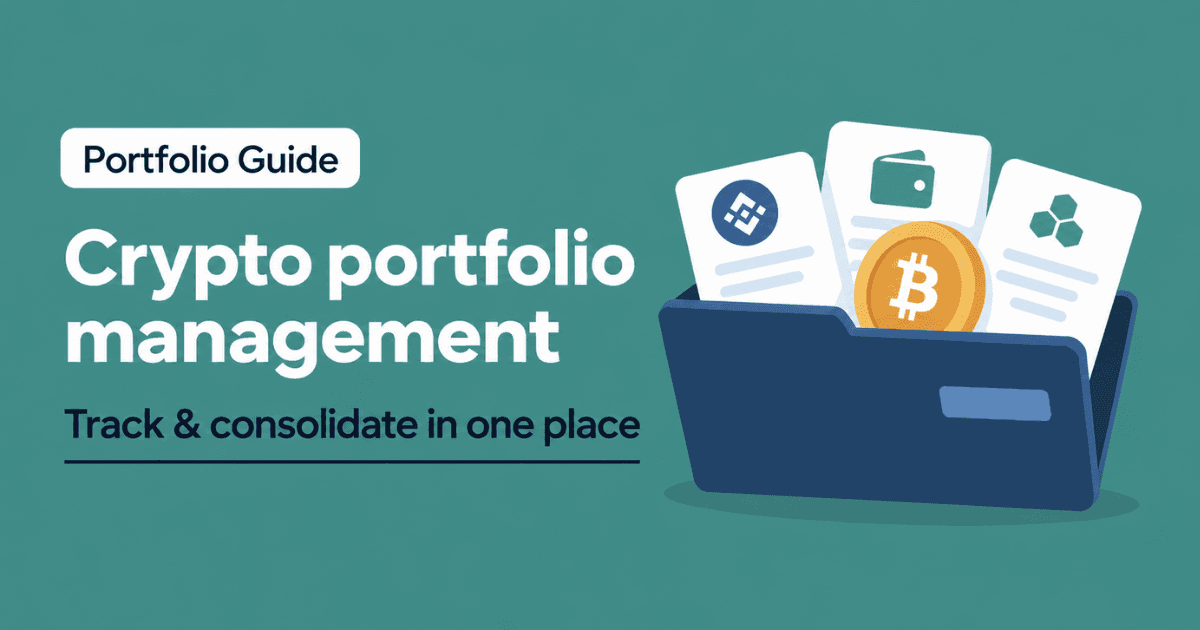
A crypto portfolio can look simple on the surface: a few coins, a few exchanges, maybe one wallet.
The difficulty starts when the history behind those holdings spreads out. One platform shows the current balance. Another holds the original purchase. A wallet contains assets that moved years ago. Rewards arrive separately. DeFi transactions add swaps, gas fees, liquidity movements or bridge activity.
At that point, portfolio tracking needs more than a price chart.
Good crypto portfolio management means knowing what you hold, where it came from, what it cost, how it moved, what profit or loss has already been realised, and which records will support future reporting. It also means keeping the portfolio readable before tax season, not rebuilding everything at the last minute.
This article explains how to track and consolidate a crypto portfolio across exchanges, wallets and DeFi activity. It also covers what to look for in crypto portfolio management tools, where manual tracking breaks down, and how to keep records tax-ready without going into country-specific tax rules.
Key takeaways
- Crypto portfolio management needs more than current balances and market prices.
- A consolidated portfolio should connect exchanges, wallets, rewards, DeFi activity, fees and older records.
- Cost-basis tracking helps explain the history behind each holding and later disposal.
- Transfers between a user’s own wallets or exchanges need matching so they do not distort the portfolio.
- Manual spreadsheets can work for simple histories but become harder to maintain as transaction volume grows.
- Good crypto portfolio management tools should support exchange connections, wallet data, DeFi records, transfer matching and exportable reports.
- Tax-ready records do not replace tax advice, but they make future reporting much easier.
No credit card required
What crypto portfolio management really means
Crypto portfolio management is the process of tracking holdings, transaction history, portfolio value, cost basis, realised P&L and unrealised P&L across all places where crypto activity happens.
It is not the same as watching prices.
A price tracker can show whether BTC, ETH or SOL moved today. That helps with market awareness, but it does not explain the user’s own position. It does not show the original acquisition history, transfer path, fees, rewards or realised results.
A portfolio management workflow should answer practical questions:
- What assets are currently held?
- Which exchanges or wallets hold them?
- What transaction history supports each position?
- What has already been sold or swapped?
- What profit or loss has already been realised?
- What unrealised gain or loss remains in current holdings?
- Which records would be needed for future reports?
The more active the user is, the more important this becomes. A simple exchange balance may work for someone who buys and holds on one platform. It usually fails once assets move across several accounts.
Why exchange balances are not enough
An exchange balance only shows what exists on that exchange at that moment. It does not always explain how the asset got there.
That creates several blind spots.
A user may buy crypto on one exchange, move it to a wallet, then later send it to another platform. The final exchange may show the current holding or sale, but not the original purchase. A wallet may show a token balance, but not the cost basis behind it. A DeFi app may show liquidity positions, but not the full transaction trail.
Balances also miss history.
A user who holds 1 ETH today may have bought 2 ETH, sold 0.5 ETH, paid fees, transferred 0.3 ETH to another wallet and received a small reward. The balance alone does not explain any of that.
This is why serious portfolio management starts with transaction history. The balance tells the user what remains. The history explains why it remains and what has already happened.
The records every portfolio needs
A tax-ready crypto portfolio needs records from every place where the user bought, sold, swapped, transferred, received or spent crypto.
The exact list depends on the user’s activity, but most portfolios should include:
- exchange transaction histories
- buy, sell and swap records
- deposits and withdrawals
- wallet addresses
- transaction hashes
- DeFi wallet activity
- staking, reward and airdrop records
- fee records, including network fees
- stablecoin transactions
- NFT activity, if relevant
- previous-year reports or old spreadsheets
- manual notes for unsupported activity
The goal is not to collect files for the sake of it. The goal is to make the portfolio explainable.
If a token was acquired, the portfolio should show how. If it moved, the portfolio should show where. If it was sold or swapped, the portfolio should show what happened to the position. If a reward was received, the portfolio should keep that receipt separate from a normal purchase.
Good records reduce the chance of missing cost basis, duplicate entries, unexplained balances and last-minute reconstruction work.
How portfolio consolidation works
Portfolio consolidation means bringing exchange, wallet and DeFi records into one connected view.
This matters because the same asset may move through several places before it is sold or held long term.
A simple chain might look like this:
Exchange purchase → wallet transfer → DeFi activity → exchange sale.
If those records stay separate, the user may see four disconnected entries. When they are consolidated, the portfolio can show one asset journey.
A good consolidation process usually follows this order:
- List every exchange, wallet and platform used.
- Download or connect the transaction history from each source.
- Add older records where current holdings or disposals depend on them.
- Match transfers between accounts owned by the same user.
- Separate income-type receipts from normal purchases.
- Review missing prices, missing cost basis and unsupported transactions.
- Compare final balances with the actual exchanges and wallets.
The most important step is transfer matching. Without it, a movement from one wallet to another may look like a sale in one place and a new acquisition in another.
Cost-basis tracking across exchanges and wallets
Cost basis is one of the main reasons portfolio consolidation matters.
When a user sells or swaps an asset, the result often depends on what they originally paid for it, plus relevant costs. If the acquisition record sits on another platform, the current exchange may not have enough information to calculate the result.
For example, a user might buy BTC on Exchange A, move it to a wallet, then later sell it on Exchange B. Exchange B can show the sale, but it may not know the purchase price from Exchange A. Without consolidation, the asset may show missing cost basis.
Cost-basis tracking should connect:
- the original acquisition
- any relevant fees
- transfers between accounts
- partial sales
- swaps
- rewards or non-purchase receipts
- later disposals
This becomes more difficult when the user has older files, closed accounts, token migrations, DeFi activity or manually entered transactions.
A portfolio management tool should make these gaps visible. It should not hide missing acquisition history behind a clean dashboard.
DeFi portfolio tracking: what makes it harder
DeFi portfolio tracking adds another layer because the activity does not always look like a simple exchange trade.
A wallet may interact with decentralised exchanges, bridges, staking contracts, lending protocols, liquidity pools or NFT marketplaces. Some transactions may include several actions inside one blockchain record. Gas fees may also affect the history and final position.
A DeFi portfolio tracker should help users connect wallet activity with the rest of the portfolio. It should also make unclear records easy to review.
Common DeFi tracking issues include:
- wallet transfers mistaken for disposals
- bridge transactions split across chains
- swaps without clear labels
- staking or reward receipts
- liquidity pool deposits and withdrawals
- missing token prices
- gas fees not reflected correctly
- unsupported protocol activity
- spam tokens or irrelevant wallet activity
This does not mean every DeFi user needs a complex system. It means wallet history should not sit outside the portfolio. If DeFi activity affects holdings, P&L or later reporting, it should be included in the same consolidated record.
DeFi support, automatic classification and tax treatment can vary by blockchain, protocol and jurisdiction, so unsupported or unclear transactions still need review.
Manual tracking vs crypto portfolio management tools
Manual tracking can work when the portfolio is small.
A spreadsheet may be enough for a user who buys a few assets on one exchange and rarely transfers anything. They can record the date, asset, quantity, price, fee and notes manually.
The problem appears as soon as the history grows.
Manual records become harder when the user has multiple exchanges, wallet transfers, rewards, DeFi activity, partial sales, old files, changing token prices and different reporting needs. A spreadsheet can still help, but it becomes easier to miss a row, duplicate a transaction or use inconsistent values.
A tool-based workflow can reduce that work by importing exchange files, connecting supported accounts, organising wallet records, calculating portfolio positions and highlighting issues that need review.
The choice does not have to be all-or-nothing.
Some users still keep a manual note for special transactions while using a portfolio tool for the main history. That can work well when the tool handles the routine records and the user keeps context for anything unusual.
What to look for in a crypto portfolio management tool
A good crypto portfolio management tool should help the user understand the portfolio, not just display a number.
Look for features that support the full record lifecycle:
| Feature | Why it matters |
| Exchange connections | Helps import trading history from centralised platforms |
| CSV upload support | Useful for older records, closed accounts or adviser review |
| Wallet tracking | Helps include self-custody activity in the same portfolio |
| DeFi support | Helps review swaps, bridges, staking and protocol activity |
| Transfer matching | Reduces false disposals and duplicate movements |
| Cost-basis tracking | Connects acquisitions with later sales or swaps |
| Realised P&L view | Shows results from closed or disposed positions |
| Unrealised P&L view | Shows gains or losses on assets still held |
| Error or warning checks | Highlights missing prices, unsupported rows or incomplete history |
| Exportable records | Helps prepare reports for review, accounting or tax workflows |
The most useful tool is the one that makes gaps visible. A clean interface is helpful, but clean data matters more.
Users should also check supported exchanges, supported wallets, file formats, API options, price support, reporting currency options and the ability to export records when needed.
How to stay tax-ready across exchanges and wallets
Tax-ready portfolio management means keeping records organised before tax time arrives.
It does not mean applying one tax rule to every country. Crypto tax treatment depends on the user’s location, transaction type, reporting period and local law. This article covers general recordkeeping principles, so it does not cover rates, deadlines or country-specific forms.
The general recordkeeping principles still apply.
A tax-ready portfolio should make it easier to show:
- acquisition history
- disposals or realised events
- transfer history
- wallet ownership
- cost basis
- fees
- rewards and other receipts
- market values used in reports
- source files behind the calculation
This is where portfolio management and tax preparation overlap. The same records that help users understand their holdings can also help them prepare for reporting later.
How cryptact helps with portfolio management
cryptact helps users bring exchange and wallet records into one place for portfolio and P&L review.
The Portfolio screen can show market value, book value, average acquisition price and unrealised gain or loss based on imported transaction history. Users can also review profit and loss calculations and check the records behind those results.
This matters because portfolio management depends on connected history. A sale on one exchange may rely on a purchase from another. A wallet transfer may need matching. A reward may affect both the portfolio and later reporting records. cryptact helps organise those entries so users can review the position more clearly.
A practical workflow looks like this:
- Add exchange histories, wallet records and older files where needed.
- Review invalid or unsupported transactions.
- Check missing prices, missing cost basis and unexpected balances.
- Review portfolio holdings, realised P&L and unrealised P&L.
- Export or use the records for reporting, adviser review or future tax preparation.
For users who want an AI-assisted workflow, cryptact also provides an AI / MCP integration that lets compatible AI assistants work with cryptact portfolio, P&L and transaction data. The broader concept is explained in cryptact’s guide to what MCP is and how it works with Claude and ChatGPT.
To review the product features, see cryptact’s portfolio and tax calculation features and the Portfolio Guide.
Crypto portfolio management FAQs
What is crypto portfolio management?
Crypto portfolio management is the process of tracking holdings, transaction history, cost basis, realised P&L and unrealised P&L across exchanges, wallets and other crypto platforms.
Is a crypto portfolio tracker the same as a price tracker?
No. A price tracker shows market prices. A portfolio tracker should connect those prices with the user’s own holdings, transaction history and P&L.
Why is portfolio consolidation important?
Consolidation helps connect activity across exchanges and wallets. Without it, transfers may look like disposals, sales may show missing cost basis, and balances may not match the full history.
What is a DeFi portfolio tracker?
A DeFi portfolio tracker helps users review wallet and protocol activity such as swaps, bridges, staking, liquidity positions, rewards and gas fees.
Why does cost-basis tracking matter?
Cost-basis tracking connects the original acquisition of an asset with later sales, swaps or other disposals. Without it, portfolio P&L and tax-ready records can become unreliable.
Can spreadsheets work for crypto portfolio management?
Spreadsheets can work for simple portfolios, but they become harder to maintain when users have several exchanges, wallets, rewards, DeFi activity and older records.
What does tax-ready mean for a crypto portfolio?
Tax-ready means the portfolio has organised records that can support future reporting. It does not mean the same tax rule applies everywhere.
How does cryptact help with portfolio management?
cryptact helps users organise exchange and wallet records, review portfolio holdings, check realised and unrealised P&L, and prepare records for reporting workflows.
Conclusion
Crypto portfolio management is not only about checking coin prices. It is about keeping the full history behind each holding clear enough to review, consolidate and report when needed.
As activity spreads across exchanges, wallets and DeFi protocols, users need more than separate dashboards. They need connected records, transfer matching, cost-basis tracking, P&L review and exportable support files.
A manual spreadsheet may work for a small portfolio. Larger histories usually need a more structured workflow.
Use cryptact to consolidate crypto activity across exchanges and wallets, review portfolio holdings and P&L, track cost basis, and keep records easier to prepare for future reporting.