Fact-checked and reviewed by MetaCounts.co, a Vancouver-based cryptocurrency accounting firm staffed by Chartered Professional Accountants (CPAs).
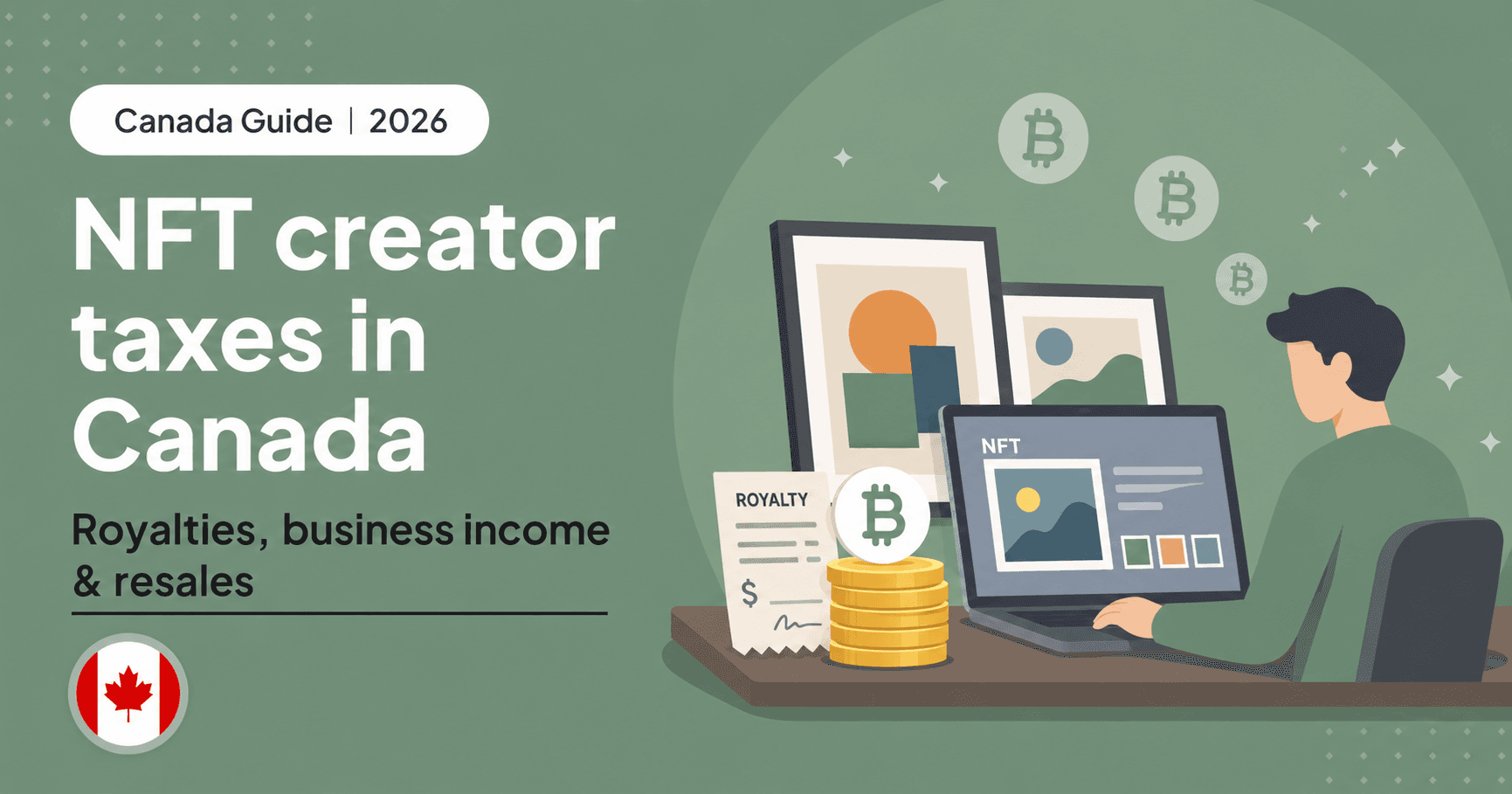
NFT creator tax in Canada usually starts with one question before anything else: are you creating and monetizing NFTs as a business? CRA now expressly includes NFTs in its list of crypto-assets, and its general crypto guidance says crypto results are reported as either business income or capital gains depending on the facts. For most active creators, mint revenue and creator royalties usually fit the business-income side more naturally than the capital-gain side, because the creator is not just disposing of an investment. They are producing and monetizing digital property in a profit-seeking way.
That distinction matters because the tax story often has more than one layer. The first layer is the NFT sale or royalty itself. The second layer can arise later if the creator was paid in crypto and then disposes of that crypto. So a creator may have business revenue when the NFT is sold, and then a separate crypto tax result when the ETH, SOL, or other token received is later sold or swapped. CRA’s barter and crypto guidance makes that timing issue especially important whenever payment is received in crypto rather than in Canadian dollars.
This guide keeps the focus on the main rule, the main reporting route, and the practical places where NFT creator files usually go wrong: royalties, resales, crypto receipts, and GST/HST.
Key takeaways
- CRA includes NFTs in its broader crypto-asset framework, so NFT creator income is analyzed using the same business-versus-capital approach CRA applies to other crypto activity.
- For most active NFT creators, primary sale proceeds and secondary-sale royalties usually fit business income more naturally than capital gains. CRA’s artists and writers folio says a self-employed creator operating in pursuit of profit with business-like behaviour is generally carrying on a business, and royalty income is business income when it relates to that business or to originating the property that generates the royalties.
- If you are carrying on a business, Form T2125 is the main reporting route for income and expenses. This is where creators generally report gross NFT income and allowable business expenses, so deductible costs such as platform fees, software subscriptions, and other eligible creation-related expenses reduce the net income figure reported through the return.
- If you receive crypto instead of cash, you still need a Canadian-dollar value when the NFT sale or royalty is received. A later sale of that crypto can create a separate tax result.
- GST/HST can also matter. CRA says that when a GST/HST registrant accepts crypto as payment for taxable property or services, the tax is calculated using the crypto’s fair market value at the time of the transaction. It also says that crypto-assets that do not meet the virtual payment instrument definition are likely taxable supplies of intangible personal property when sold. Smaller creators should also remember the general small supplier threshold, which is usually C$30,000 in taxable supplies over four consecutive calendar quarters, so GST/HST registration may not arise immediately in every case.
No credit card required
Why NFT creator income is usually a business question
CRA does not publish a dedicated NFT creator tax page, but its broader framework points in a clear direction. It says NFTs are crypto-assets, and it says crypto results are reported as business income or capital gains depending on the circumstances. Separately, CRA’s artists and writers folio says a self-employed creator is generally operating a business where the activity is undertaken in pursuit of profit and there is objective evidence of business-like behaviour. That fits many NFT creators far better than a passive-investor analysis does.
That is why the main creator question is not “Is this an NFT?” It is “What are you doing with it?” If you are minting works, listing them for sale, promoting them, earning royalties, and repeating the process, the file starts to look like business income. By contrast, a person who simply bought someone else’s NFT and later sold it may be closer to the ordinary capital-versus-business analysis that applies to other crypto investments. For this article, though, the main focus is creator-side income.
When mint proceeds and royalties become taxable
For most active creators, the tax point starts when the NFT is sold or when a royalty is credited. The creator has produced something and received consideration for it. CRA’s general business-income materials say business income includes income from activities done for profit, and its artists and writers folio says royalty income is generally business income where it relates to business activities carried on by the recipient or where the recipient is in the business of originating the property from which the royalties are received. That fits NFT creator royalties quite naturally in many cases.
That also means royalties do not become non-taxable merely because they are “passive” in a platform sense. If you are the creator and the royalties arise from the NFT business you built, they generally look more like business receipts than capital gains. A narrower rule does exist for royalties outside a business context, but the lines should be distinguished more clearly: line 10400 is generally for certain employment-source royalties, such as royalties from an employer or former employer, while line 12100 is the more common route for self-employed or passive royalties that do not form part of an active T2125 business. But for most active NFT creators, the more natural route is still business income through T2125 rather than those passive-royalty lines.
How creator royalties and resales are usually treated
The cleanest way to separate the moving pieces is to distinguish between the NFT-side receipt and the later crypto-side disposition.
If you mint an NFT and sell it, the sale proceeds generally look like business revenue if you are carrying on a creator business. If the platform later credits you a secondary-sale royalty when the NFT changes hands between collectors, that royalty usually looks like more creator income, not a capital gain. The creator did not dispose of a long-held investment at that point. They received ongoing compensation tied to the original work. CRA’s royalty guidance for artists and writers is useful here because it explicitly says royalty income is business income when it is related to business activities or to originating the property that produces the royalty stream.
The later resale question is different. If you were paid in ETH for the original NFT sale or for the royalty, and you later dispose of that ETH, that later transaction has to be analyzed as a crypto disposition in its own right. CRA’s crypto guidance says dispositions create either business income or capital gains depending on the facts, and its barter guidance says a vendor receiving crypto must value the consideration at the time of the transaction. So the receipt of crypto does not wait for “cashing out” before it becomes relevant. The Canadian-dollar value at receipt already matters, and the later crypto sale can create a second tax event.
How NFT creator income is usually taxed
| Creator event | Tax treatment that usually fits best | Main reporting route | What to track |
| Minting and selling your own NFT | Usually business income | T2125 | Sale date, buyer-side consideration, CAD value |
| Receiving secondary-sale creator royalties | Usually business income | T2125 | Royalty date, amount, platform statement, CAD value |
| Being paid in ETH, SOL, or other crypto | Revenue still valued when received | T2125 for the receipt, then separate crypto analysis later | FMV in CAD at receipt |
| Later selling the crypto you received | Separate crypto disposition | Schedule 3 if capital account, or business route if your crypto activity is business-like | Cost base, sale value, fees |
| Selling an NFT that does not meet the virtual payment instrument definition | Likely taxable sale of intangible personal property for GST/HST purposes if other conditions are met | GST/HST analysis separate from income tax | GST/HST status, place of supply, FMV |
This is the structure that usually keeps NFT creator files from becoming messy. The first three rows are about creator income. The fourth row is about what happens later if the creator keeps the crypto instead of converting it immediately. The last row is there because GST/HST can be overlooked even when the income-tax analysis is correct.
What happens when you are paid in crypto and never cash out
This is one of the most common NFT creator misunderstandings. Not cashing out does not automatically defer the creator-income question.
CRA’s barter and GST/HST guidance says that when taxable property or services are exchanged for crypto, the fair market value at the time of the exchange matters. Its crypto recordkeeping guidance also says you should keep the number of units, date and time, Canadian-dollar value, nature of the transaction, and wallet addresses for each transaction. In practice, that means an NFT creator paid in crypto still needs to record the Canadian-dollar value when the NFT sale or royalty is received, even if the tokens stay in the wallet afterwards.
A simple example shows why this matters. Suppose you mint an NFT and sell it for one ETH when ETH is worth C$4,000. A few months later you receive a secondary-sale royalty of 0.1 ETH when that 0.1 ETH is worth C$350. If you are carrying on an NFT creator business, the practical starting point is usually C$4,350 of creator revenue across those two receipt events. If you later sell the 1.1 ETH for C$4,900, the later crypto sale is a separate tax question. The key point is that the creator income did not begin only when you converted to cash. It began when you received the crypto consideration.
Where NFT creator income goes on the return
For most active creators, the main reporting route is T2125. CRA says you use Form T2125 to report business or professional income and expenses, and its self-employment pages say gross and net self-employment income are reported on the corresponding T1 self-employment lines. That is the form most NFT creators should think about first when their sales and royalties are business income.
The capital-gain route still matters, but usually for the later disposition of crypto received or for separate NFT investment activity, not for ordinary creator revenue. CRA’s crypto guidance says capital-account dispositions include only half the capital gain in income, while business-account profits are fully reported. So if a creator later sells ETH received from NFT royalties, that later ETH sale may need its own capital-versus-business analysis. The creator should not collapse the original royalty receipt and the later crypto sale into one number.
A short GST/HST note for creators
GST/HST should not be treated as an afterthought in creator files. CRA says that if you are a GST/HST registrant and your business accepts crypto as payment for taxable property or services, you must calculate GST/HST based on the crypto’s fair market value at the time of the transaction. CRA also says that when a crypto-asset does not meet the virtual payment instrument definition, its sale is likely a taxable sale of intangible personal property. Since CRA identifies NFTs as unique crypto-assets and gives examples of virtual payment instruments such as bitcoin and ether rather than NFTs, creators should not casually assume NFT sales are exempt financial services. A closer GST/HST review is often needed.
That does not mean every NFT creator automatically has an immediate GST/HST registration issue. Small creators should still remember the general small supplier threshold, which is usually C$30,000 in taxable supplies over four consecutive calendar quarters. So the practical point is not that every creator must register right away, but that the GST/HST question should be checked separately instead of assuming the crypto label answers it. Income tax and GST/HST are related, but they are not the same analysis.
How cryptact helps
NFT creator tax files usually break in three places: valuing crypto receipts when the NFT is sold, separating creator income from later crypto dispositions, and preserving a clean royalty trail over time.
That is where cryptact helps in a practical way. It brings exchange and wallet data together, makes it easier to track what was received and when, and helps keep later crypto sales from being mixed into the original creator-income calculation. For NFT creators dealing with mint proceeds, royalties, and resales paid in crypto, that structure makes the return much easier to prepare and much easier to defend.
Conclusion
A strong NFT creator tax analysis in Canada starts with one question: are you monetizing original NFT work as a business? For most active creators, the answer is often yes, which means mint proceeds and creator royalties usually belong in the business-income framework rather than being treated like capital gains from an investment. That is the main reason T2125 is usually the more important form for creators than Schedule 3, at least for the sale and royalty side of the story.
The next step is keeping the layers separate. The NFT sale or royalty can be one taxable event. The later sale of the crypto you received can be another. GST/HST may be a third issue if you are a registrant making taxable supplies. That is also where cryptact adds real value. It helps keep the receipt history, valuations, royalties, and later crypto disposals organized enough that the final CRA reporting is far easier to prepare and support.