Fact-checked and reviewed by Scott Lynch (Beanstalk Accountants), Chartered Accountant.
Australia does not set a separate tax deadline for crypto. You report crypto gains, losses and income through the same return that covers your salary, investments, deductions and other taxable amounts.
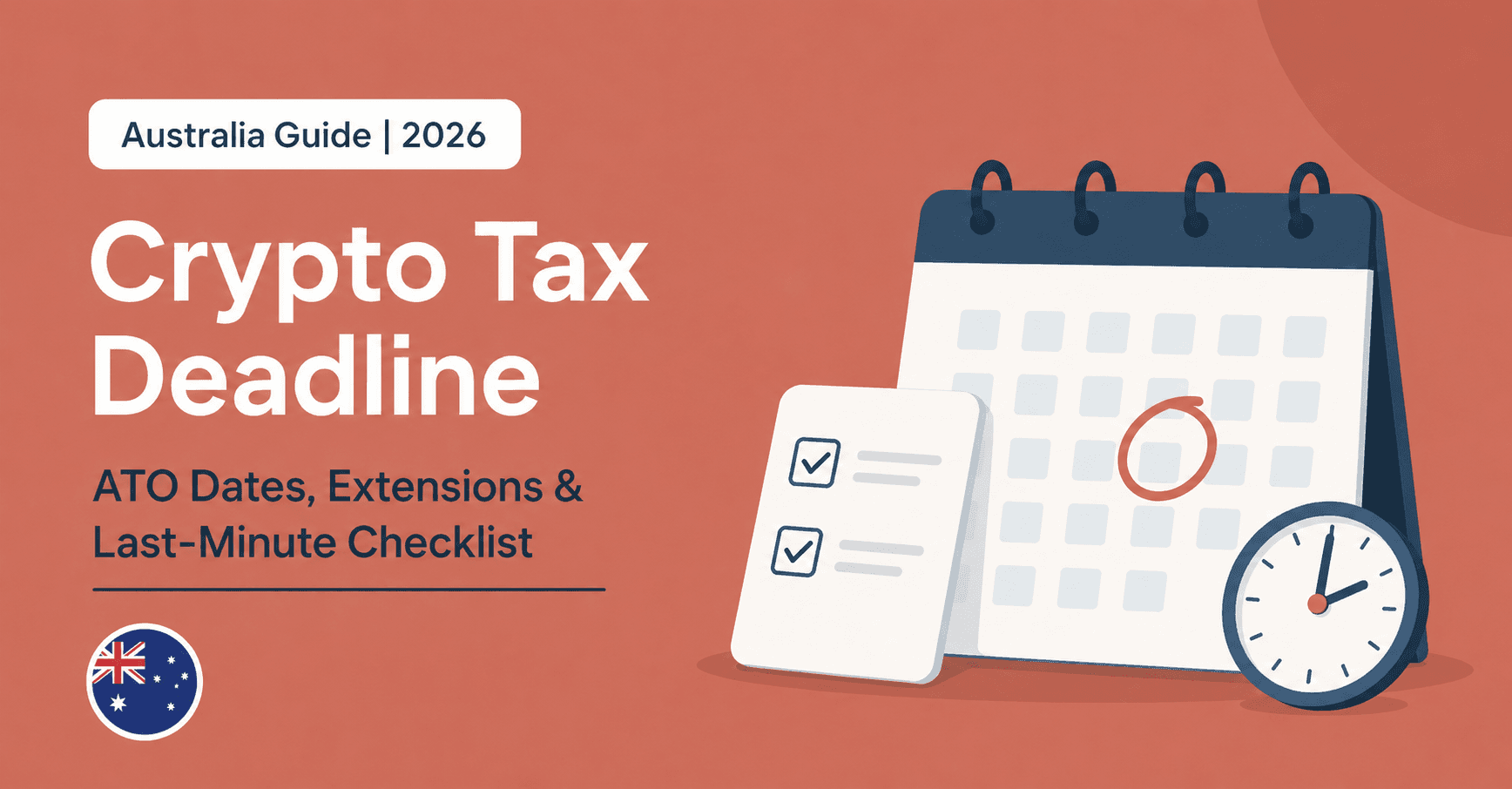
The 2026 return covers transactions from 1 July 2025 to 30 June 2026. Most individuals who lodge their own return face a standard deadline of 31 October. Since 31 October 2026 falls on a Saturday, the due date moves to the next business day, Monday, 2 November 2026.
A registered tax agent may give you access to a later lodgment date. You still need to appoint the agent on time and confirm the date that applies to your return. Crypto records often take longer to prepare than expected, so the filing deadline should mark the end of your reconciliation work, not the day you start it.
Key takeaways
- The 2026 tax return covers crypto activity from 1 July 2025 to 30 June 2026.
- Most people lodging through myTax can lodge by Monday, 2 November 2026 because 31 October falls on a Saturday.
- Registered tax agents may have later dates under the ATO lodgment program.
- A complicated crypto history does not give you an automatic extension.
- The ATO may impose a failure-to-lodge penalty when you miss the due date.
- Pre-fill information does not replace your own crypto gain, loss and income calculations.
Keen to learn more about how crypto is taxed in Australia? This guide has you covered: Understanding Crypto Tax in Australia: A Comprehensive Guide
Table of contents |
No credit card required
Which crypto tax deadline applies in 2026?
Your lodgment method decides which deadline you need to follow. Most individuals either lodge through myTax or use a registered tax agent.
| Your filing position | Deadline or timing | What you need to do |
| You lodge through myTax | 2 November 2026 | Complete and submit the return by the next business day after 31 October |
| You use a registered tax agent | 31 January 2027 28 February 2027 31 March 2027 15 May 2027 | Join the agent’s client list on time and ask them to confirm your due date |
| You have overdue earlier returns | 2 November 2026 | Complete and submit the return by the next business day after 31 October |
| The ATO gives you a specific date | Date shown by the ATO | Follow the date in the notice or online account |
The table covers lodgment dates, not payment dates. If your return produces a tax bill, your notice of assessment will state when you need to pay it.
You should also check whether you need to lodge at all. A person may still need a return even after an exchange withholds tax or supplies transaction data to the ATO. Pre-fill records and third-party reporting do not complete the filing obligation for you.
Lodging your own return through myTax
myTax opens after the income year ends on 30 June. You can start preparing the return from July, but early access does not mean every figure will already appear in your account.
Employers, banks, health funds and other organisations send information to the ATO at different times. Much of that data arrives by late July. Crypto pre-fill information may only indicate that the ATO has received records connected with a crypto account.
It will not calculate every disposal, acquisition cost, capital loss or income amount for you. You need to work out the tax result before entering the final figures in myTax.
For example, an exchange may report that you sold crypto during the year. That information does not tell the ATO whether you bought the asset on another platform, moved it through a personal wallet, paid transaction fees or held it long enough to qualify for the CGT discount.
Review any pre-filled information rather than accepting it without checking. Correct missing or inaccurate figures before you lodge.
Using a registered tax agent
A registered tax agent may lodge your return after the standard myTax deadline under the ATO’s agent lodgment program. The exact date can depend on your filing history and the category that applies to your return.
You generally need to appoint the agent by 31 October. Contacting an agent after your own deadline has passed does not guarantee a later date.
Ask the agent to confirm your deadline when you engage them. Do not assume that you will receive the same date as a friend, family member or previous-year client.
Earlier returns can also affect your position. If you have overdue returns, the ATO may require you to lodge sooner than other clients covered by the agent program.
Using an agent gives you more preparation time in some cases. It does not change which transactions belong in the 2025–26 income year.
Can you get more time to lodge?
The ATO may grant more time when circumstances outside your control prevent you from meeting the deadline. Serious illness, natural disasters and major system problems can support a request.
A large number of crypto transactions does not create an automatic extension. Neither do missing cost records, several wallets or difficulty exporting data from an exchange.
Contact the ATO or your tax agent before the due date where possible. Explain what happened, how it affected your ability to lodge and when you expect to complete the return.
Do not assume the ATO has accepted the request until you receive confirmation. Keep gathering and reconciling the records while you wait for a response.
Tax agents can also request deferrals for eligible clients. Your agent will need enough information to explain the delay and propose a reasonable new date.
What happens when you lodge late?
The ATO can apply a failure-to-lodge-on-time penalty when you miss the deadline. It considers the taxpayer’s circumstances, the length of the delay and the type of document involved.
An unpaid tax debt can also attract interest. Lodging late does not postpone the income year or move the crypto transactions into the next return.
The ATO receives crypto account and transaction information from service providers through its data-matching program. It can compare that information with the income, gains and losses shown in your return.
Data matching does not mean the ATO already knows your correct tax result. It means an omitted account or disposal may still appear in the information available to the department.
If you notice a mistake after filing, amend the return as soon as you can. You can request an amendment through ATO online services or ask a registered tax agent to handle it.
When to start preparing your crypto return
A clean crypto return usually starts well before October. The time-consuming part often involves rebuilding the transaction history, not entering the final figures into myTax.
July works well for collecting exchange exports, wallet histories and reward statements. During August and September, you can match transfers, investigate missing costs and review the tax treatment of unusual transactions.
Leave October for the final calculation and return preparation. This timing gives you room to contact a platform when an export does not include the required history.
You may need more time when the year includes:
- several exchanges or wallets
- crypto-to-crypto swaps
- staking rewards or airdrops
- decentralised finance activity
- NFT transactions
- lost access to an account
- foreign-currency records
- assets bought in earlier years
Do not wait for the ATO to tell you which platforms you used. Build your own list and confirm that each account appears in the final calculation.
Last-minute crypto tax checklist
The final review should connect every figure in the return with a transaction record. A neat annual summary will not help if it leaves out the original purchase, wallet movement or income value.
Check the reporting period
Include taxable events that occurred from 1 July 2025 to 30 June 2026. Do not group transactions by the calendar year.
Check the time zone used by each exchange, especially for trades made close to midnight or the end of the income year.
List every exchange and wallet
Include active accounts, closed accounts, hardware wallets, mobile wallets, staking platforms and decentralised applications.
A platform with a zero balance at 30 June may still contain purchases, disposals or transfers that affect the return.
Match your own wallet transfers
Moving crypto between accounts you own does not usually create a disposal. Match the outgoing and incoming transactions so the movement does not appear as a sale.
Keep the wallet addresses, quantity, date, transaction hash and network fee. These details help prove that ownership did not change.
Review each taxable disposal
Selling crypto for Australian dollars can trigger a CGT event. Swapping 1 crypto asset for another can also create a disposal, even when no cash enters your bank account.
Spending or gifting crypto may create another taxable event. Check the proceeds, acquisition cost, fees and dates for each disposal.
Separate income from capital gains
Staking rewards, some airdrops, mining receipts and payments received in crypto may count as ordinary income when you receive them.
A later sale can create a capital gain or loss. Keep the original income value because it may form part of the asset’s cost base.
Check Australian-dollar values
Report tax figures in Australian dollars. Keep the price source and conversion method used for transactions recorded in another currency.
Use a method that you can explain and support. Do not switch between pricing sources simply to produce a lower gain.
Investigate missing acquisition costs
A missing purchase record does not automatically mean the asset had no cost. Search bank statements, old exchange files, email confirmations and wallet histories before you finalise the return.
Missing cost information can overstate the gain. An unsupported cost can create a different problem if the ATO asks how you calculated it.
Reconcile your balances
Compare the calculated balances with the assets held across your exchanges and wallets at 30 June.
A difference may point to a missing transaction, duplicated import, unmatched transfer or fee recorded in the wrong place.
Check carried-forward losses
Review your earlier returns for unapplied net capital losses. These losses may reduce later capital gains, subject to the normal CGT rules.
Do not use a capital loss against staking income, salary or another form of ordinary income.
Save the full filing record
Keep exchange exports, wallet records, calculations, valuation evidence and a copy of the lodged return.
The ATO generally requires you to keep crypto records for 5 years. You may need to retain acquisition records for longer when you continue to hold the asset.
How cryptact helps
Crypto tax work becomes harder when the purchase appears on 1 exchange, the asset moves through 2 wallets and the sale takes place on another platform. Reviewing each file separately can leave gaps in the cost history.
cryptact brings exchange and wallet records into 1 transaction history. It helps identify internal transfers, missing data, income receipts and disposals before you prepare the final tax figures.
The report still needs accurate source data and a review of unusual transactions. Once the records connect properly, you or your tax agent can spend less time rebuilding the history close to the deadline.
Conclusion
The 2026 crypto tax deadline depends on how you lodge. People filing through myTax have until 2 November 2026 because the standard 31 October date falls on a Saturday. Tax agent clients may receive a later date, but they need to engage the agent on time and confirm their own position.
Start with the records, not the return form. cryptact helps connect activity across exchanges and wallets so you can review gains, losses and crypto income before the lodgment date arrives. A complete transaction history gives you a stronger filing result than pre-fill data or a last-minute estimate.