Fact-checked and reviewed by Scott Lynch (Beanstalk Accountants), Chartered Accountant.
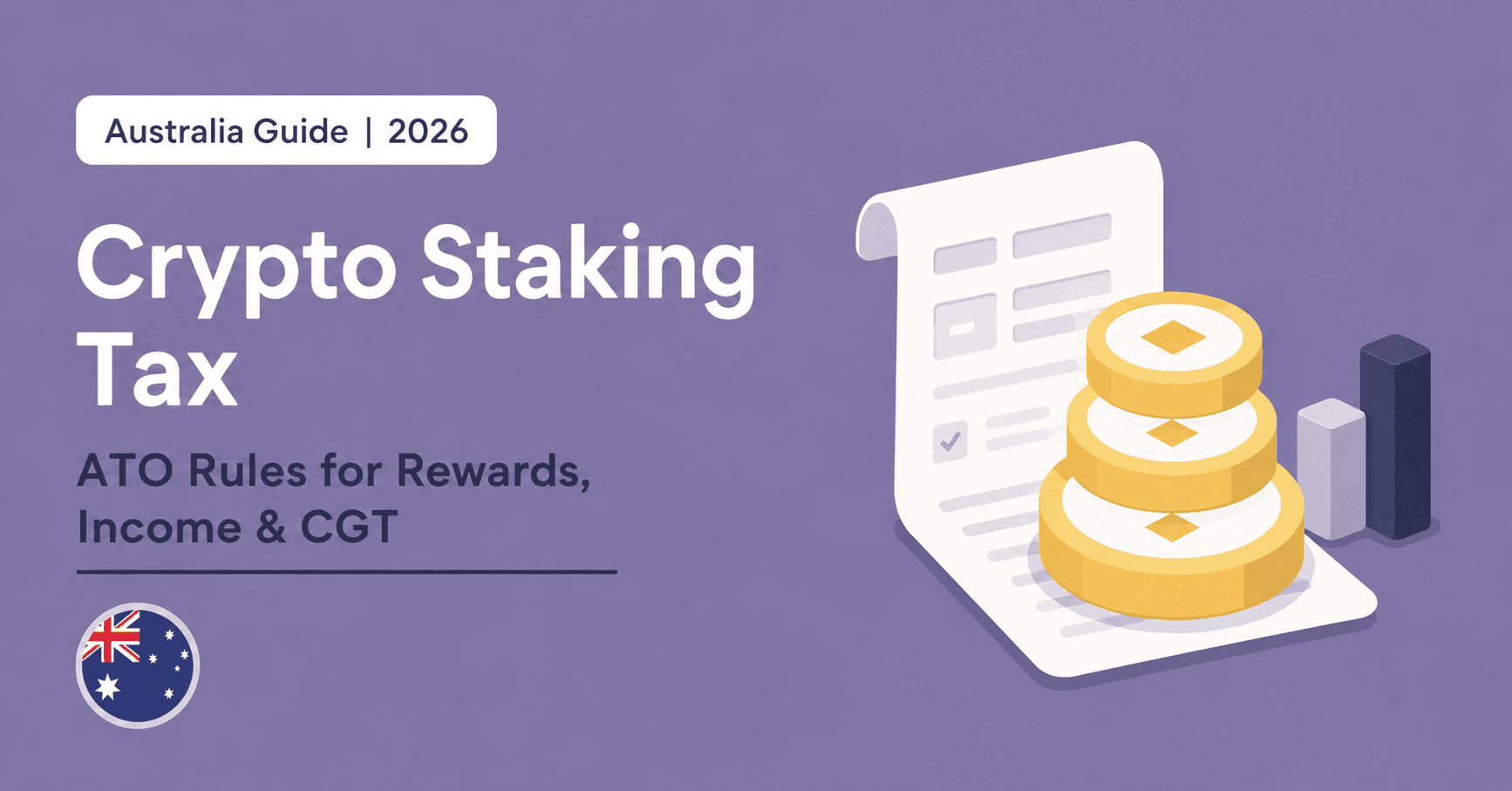
Staking can create two separate tax events in Australia. The first can arise when you receive the reward tokens. The second can arise later when you sell, swap, spend, or otherwise dispose of those tokens. Treating the entire process as one transaction is one of the most common reasons staking records become difficult to reconcile.
The ATO treats rewards received from staking crypto assets as ordinary income. You generally need to include the Australian-dollar market value of the rewards in your assessable income when you receive them. This applies even if the rewards remain in your wallet and are never converted into Australian dollars.
That value also becomes important later because it generally forms the cost base of the reward tokens. If you eventually dispose of them, you calculate the capital gain or loss using the value previously recognised as income rather than treating the tokens as having been acquired for nothing.
This guide explains when staking rewards become taxable, how the income and CGT calculations fit together, where individual investors report the income, and which records should be kept from the moment each reward is received.
Key takeaways
- Staking rewards are generally ordinary income when received, based on their market value in Australian dollars at that time.
- You may owe income tax on staking rewards even if you continue holding them and never cash out.
- The value included as ordinary income generally becomes the cost base of the reward tokens.
- Selling, swapping, spending, or gifting the reward tokens later can trigger a separate CGT event.
- Individual investors generally report staking rewards under Other income, while taxpayers carrying on a crypto business may need to report them as business income.
- Each reward receipt needs its own date, quantity, Australian-dollar value, and transaction record.
Keen to learn more about how crypto is taxed in Australia? This guide has you covered:Understanding Crypto Tax in Australia: A Comprehensive Guide
Table of contents |
No credit card required
Why staking can create two tax events
Staking usually involves committing or allocating crypto assets to support the operation of a proof-of-stake network. Depending on the arrangement, you may operate a validator, delegate tokens to another validator, or use staking services provided by an exchange or platform. In return, additional tokens may be credited or allocated to you.
The original tokens and the reward tokens must be kept separate for tax purposes. Locking the original tokens does not automatically mean that they have been sold. The new rewards, however, can create assessable income when they are received.
The later disposal of those rewards is a different event. Once you sell the tokens for Australian dollars, swap them for another crypto asset, use them to make a purchase, or give them away, the CGT rules may apply.
This creates a two-stage calculation:
- Income stage: Include the market value of the reward in ordinary income when it is received.
- Disposal stage: Calculate the capital gain or loss when the reward token is later disposed of.
The second stage is not double taxation of the same amount. The market value already included in income generally becomes the cost base, so CGT applies only to the subsequent movement in value.
When the ATO treats staking rewards as ordinary income
The ATO’s current position is that rewards received from staking crypto assets are ordinary income. The amount included in the tax return is the market value of the additional tokens in Australian dollars at the time they are received.
Receipt does not depend on converting the tokens into cash. If a staking reward is credited to your exchange account or wallet and is available to you, continuing to hold it does not defer the income-tax treatment.
Suppose a staking platform credits you with SOL worth A$300. You do not sell it and leave it in the account. The A$300 is still generally assessable income for the income year in which the reward was received. Whether its value later rises or falls does not alter the original income amount.
The timing can require closer attention where rewards accumulate within a protocol before they can be withdrawn. The practical question is when the tokens are received, allocated, or otherwise made available to you rather than when you later choose to withdraw them. The platform’s reward statements and the terms of the staking arrangement can help identify that point.
The reward should be valued using a reasonable and supportable market price in Australian dollars. If the token is not directly traded against AUD, you may need to convert its value using a reliable exchange price and retain evidence of the method used.
How different staking arrangements are usually treated
The method used to stake can affect the records you receive, but it does not normally remove the ordinary-income treatment of the rewards.
| Staking arrangement | Treatment of the reward | Record that matters most |
| Running your own validator | Reward is generally ordinary income when received | Blockchain reward record and AUD market value |
| Delegating tokens to a validator | Your share of the rewards is generally ordinary income | Delegation statement, wallet entry, and receipt value |
| Staking through a centralised exchange | Reward is generally ordinary income when credited or made available | Exchange reward history and AUD value |
| Staking through a pool | Distributed rewards are generally ordinary income | Pool statement, distribution date, and token quantity |
| Receiving rewards in a different token | Market value of the token received is generally ordinary income | Token received, quantity, and AUD value at receipt |
| Conducting staking as part of a crypto business | Rewards may form part of business income | Business accounts and trading-stock records where relevant |
A platform may describe the payment as a bonus, yield, distribution, or staking return. The commercial label does not necessarily change the tax treatment if the token was received as a reward for staking.
Some products marketed as staking may instead involve lending, decentralised finance, or transferring tokens in exchange for a liquid-staking token. Those arrangements can create additional CGT questions if the taxpayer gives up beneficial ownership of the original asset or exchanges it for a different token. This is a narrower issue and should be reviewed separately from the taxation of the periodic reward.
How staking rewards receive their cost base
The ordinary-income value of a staking reward generally becomes the first element of its cost base. This prevents the same receipt value from being taxed again when the token is sold.
Assume you receive staking rewards with a market value of A$1,000. You include A$1,000 as ordinary income for that year. Several months later, you sell the reward tokens for A$1,350.
The tax treatment is generally divided as follows:
- ordinary income when received: A$1,000;
- disposal proceeds: A$1,350;
- cost base of the reward tokens: A$1,000;
- capital gain before any other eligible cost-base adjustments: A$350.
If the tokens instead fall in value and are sold for A$700, the original A$1,000 remains ordinary income for the year of receipt. The later sale may produce a capital loss of A$300. The reduction in value does not retrospectively reduce the income recognised when the tokens were received.
Each reward batch has its own acquisition date and cost base. If rewards are distributed daily or weekly, combining them into one unsupported annual figure can make the later CGT calculation inaccurate. A reasonable record should preserve the quantity, receipt date, and market value of each distribution or a supportable grouped calculation based on the platform data.
The ordinary CGT discount may become relevant if an individual holds a particular batch of reward tokens for at least twelve months before disposal and the other eligibility rules are met. The holding period for the reward tokens begins when those tokens are acquired, not when the original staked assets were purchased.
Reporting staking rewards in myTax
For an individual investor, the ATO directs staking rewards to Other income in the tax return. The amount reported is the total Australian-dollar value of the rewards derived during the income year.
The reporting process is generally:
- obtain the complete staking reward history;
- identify when each reward was received or made available;
- convert each reward to Australian dollars using a reasonable market value;
- total the income for the relevant income year; and
- report the total under Other income.
The later disposal does not belong in the same income entry. Any capital gain or loss from selling, swapping, spending, or gifting the reward tokens is handled separately through the CGT section of the return.
Taxpayers carrying on a genuine crypto business may need to report staking receipts as business income instead. In those circumstances, the tokens may also need to be considered under the trading-stock rules. The classification depends on the scale, regularity, commercial organisation, and purpose of the activity rather than the number of reward payments alone.
Staking rewards should not be entered as interest merely because they produce a return over time. The ATO specifically identifies staking rewards as crypto-related ordinary income and directs individual investors to Other income.
Records needed for staking income and CGT
Staking creates more data than a normal purchase because the taxpayer may receive many small token distributions throughout the year. The income calculation cannot be supported using only the balance shown at year-end.
The records should include:
- the name and quantity of each reward token;
- the date and time the reward was received;
- the Australian-dollar market value at that time;
- the exchange rate or valuation source used;
- the wallet address or exchange account involved;
- staking, validator, or pool statements;
- transaction hashes where rewards are distributed on-chain;
- any directly related fees;
- the date and value of each later disposal; and
- calculations linking each disposal to the relevant cost base.
The ATO generally requires crypto records to be retained for five years. Records may need to be kept longer where the asset is still held, because the cost-base evidence will be needed when the token is eventually disposed of.
Internal transfers should also be identified correctly. Moving reward tokens from an exchange to your own wallet does not ordinarily create a disposal if beneficial ownership remains unchanged. Without clear wallet ownership records, software may incorrectly treat the outbound and inbound entries as separate taxable transactions.
How cryptact helps
Staking records become difficult when rewards are distributed frequently, valued at different prices, and later moved through several exchanges or wallets. A year-end platform total may show how many tokens were received, but it may not provide the Australian-dollar value required at each receipt point or preserve the cost base needed for a later sale.
cryptact helps bring the staking distributions, exchange records, and wallet activity into one transaction history. This makes it easier to calculate the Australian-dollar income value when rewards are received and carry that value forward as the cost base of the reward tokens.
It also helps separate internal wallet movements from disposals and connect later sales or swaps to the correct reward batches. For taxpayers with several staking assets or frequent distributions, that connected record helps prevent ordinary income and later capital gains from being combined or counted twice.
Conclusion
Crypto staking tax in Australia has two distinct stages. The reward is generally ordinary income when received, based on its Australian-dollar market value at that time. A later sale, swap, spend, or gift can then create a separate capital gain or loss using that income value as the reward token’s cost base.
This means holding the rewards instead of cashing out does not remove the original income-tax obligation. It also means the later CGT calculation should not begin with a nil cost base where the reward value has already been included as assessable income.
The most reliable approach is to record each reward when it is received and preserve that value until the token is eventually disposed of. cryptact helps connect those two stages by organising reward distributions, valuations, wallet transfers, and later disposals within the same transaction history. That makes it easier to report staking income accurately and calculate the resulting CGT without duplicating the amount already taxed.