Fact-checked and reviewed by Kshitij Shah (BitNine), Chartered Accountant.
Do you trade cryptocurrencies frequently? Whether you’re buying/selling within a day or using high-frequency strategies, you should be aware of how crypto tax for day traders functions in India.
In simple terms, all your crypto profits are taxed at a flat 30% under the Virtual Digital Asset (VDA) rules. This applies no matter how short-term your trades are or how often you trade. On top of that, a 1% TDS (tax deducted at source) applies to each crypto sale you make.
The rules around day trading crypto tax India are strict and uniform, which often surprises traders who expect stock-market style tax treatment. Let’s check out these rules step by step so you know what you need to report and pay. Read on!
Read more: For a full overview of how crypto is taxed in India, see our complete guide to crypto tax in India.
Table of contents |
Flat 30% Tax on Your Crypto Profits
India treats gains from any transfer of a VDA as taxable income. This includes activities such as selling Bitcoin, swapping one crypto for another, or even using crypto to buy something.
The law (Section 115BBH) makes it clear that VDA tax for day traders applies at a flat rate, regardless of trading volume, frequency, or holding period. Then there’s any applicable cess and surcharge. Below are some defining provisions under India’s crypto tax laws:
There is no distinction between short-term and long-term. The crypto day trading tax rate India remains fixed at 30%, with no slab benefits or concessions for active traders. It doesn’t make a difference whether you held the crypto for a few minutes or a few years.
You also cannot subtract any expenses or fees except the original purchase cost of the crypto. This includes exchange commissions, broker fees, electricity for mining, or hardware costs. In other words, the only “expense” you can use is what you paid to acquire the crypto; everything else is ignored for tax.
Losses from crypto trades are ignored too. If you lose money on one crypto and gain on another, you cannot offset the loss against the gain. Similarly, you cannot carry forward crypto losses to future years. Each year’s crypto gains stand on their own.
What this means for you as an intraday or high-frequency trader
There are no separate intraday crypto tax in India, but if you trade crypto actively, each sell transaction is reviewed on its own for tax purposes. Only trades that make money are counted; trades that lose money are not.
At the end of the year, the total of all your profitable trades is taxed at 30%. You can't use losses from some trades to lower gains from others, and you can't deduct trading costs that are higher than the purchase price.
As a result, even if your overall trading results feel modest, your taxable income can be much higher. As a high-frequency trader, keeping track of taxable gains can get complicated very quickly. There are hundreds of trades and strict VDA rules, so doing the math by hand can lead to mistakes. But don't worry. Tools like cryptact can make it easy to keep track of all your transactions and generate reports that are ready for tax time.
Keep in mind that the more you trade, the more important it is to keep track of every deal and plan ahead for how it will affect your taxes.
1% TDS on Every Crypto Sale
Besides the 30% tax on profits, every time you sell or transfer crypto, 1% TDS must be deducted from the sale amount under Section 194S. In practice, this means:
- 1% of the sale value is kept for each sale. For instance, if you sell cryptocurrency for ₹100,000, ₹1,000 will be taken out as TDS.
- Intraday/high-frequency trades mean more TDS deductions. The Income Tax Department clarified that if you do intraday crypto trading, “the tax shall be deducted every time a transaction is squared-off.” Basically, whenever you buy and then sell crypto in the same day, the 1% TDS kicks in on that closing trade.
- Who deducts the TDS? If you trade on an Indian crypto exchange, the platform usually automatically deducts the 1% for you and shows it in your Form 26AS (tax statement). If you trade P2P or on foreign platforms, technically the buyer of your crypto must deduct and deposit the 1% TDS. In reality, many overseas platforms don’t, but you are supposed to account for it yourself in your taxes.
- Thresholds apply. No TDS is required if your total crypto purchases from a single buyer in a year are below ₹10,000 (the limit rises to ₹50,000 if the buyer is a “specified person,” such as a business entity with Business Turnover less than Rs.1 Crore or Professional Receipts less than Rs. 50 Lakhs). But once you exceed that threshold, 1% TDS applies on every sale.
Now, to look at all of these rules simply, you still finally owe 30% on your profits. But the 1% TDS is like a deposit toward that tax. If at year-end you find the TDS collected is more than your actual liability, you can claim a refund when you file.
However, for intraday and high-frequency traders, the TDS locks up cash (since ₹1 is taken out of every ₹100 you sell). This can be a real concern, because many small-time traders often feel “the pinch” because the 1% TDS on each trade can actually affect their working capital.
How to Report Crypto Trading Income
When it comes to crypto trading income tax India, the reporting requirements are detailed, and mismatches with exchange data can attract scrutiny.
When filing your tax return, you must report your crypto gains under the new Schedule VDA (Virtual Digital Assets) starting from FY 2025-26 (assessment year 2026-27). This schedule asks for details of each transaction: date, buy value, sale value, etc. Exchanges will also send trade reports to the tax department, so your filings should match what they have.
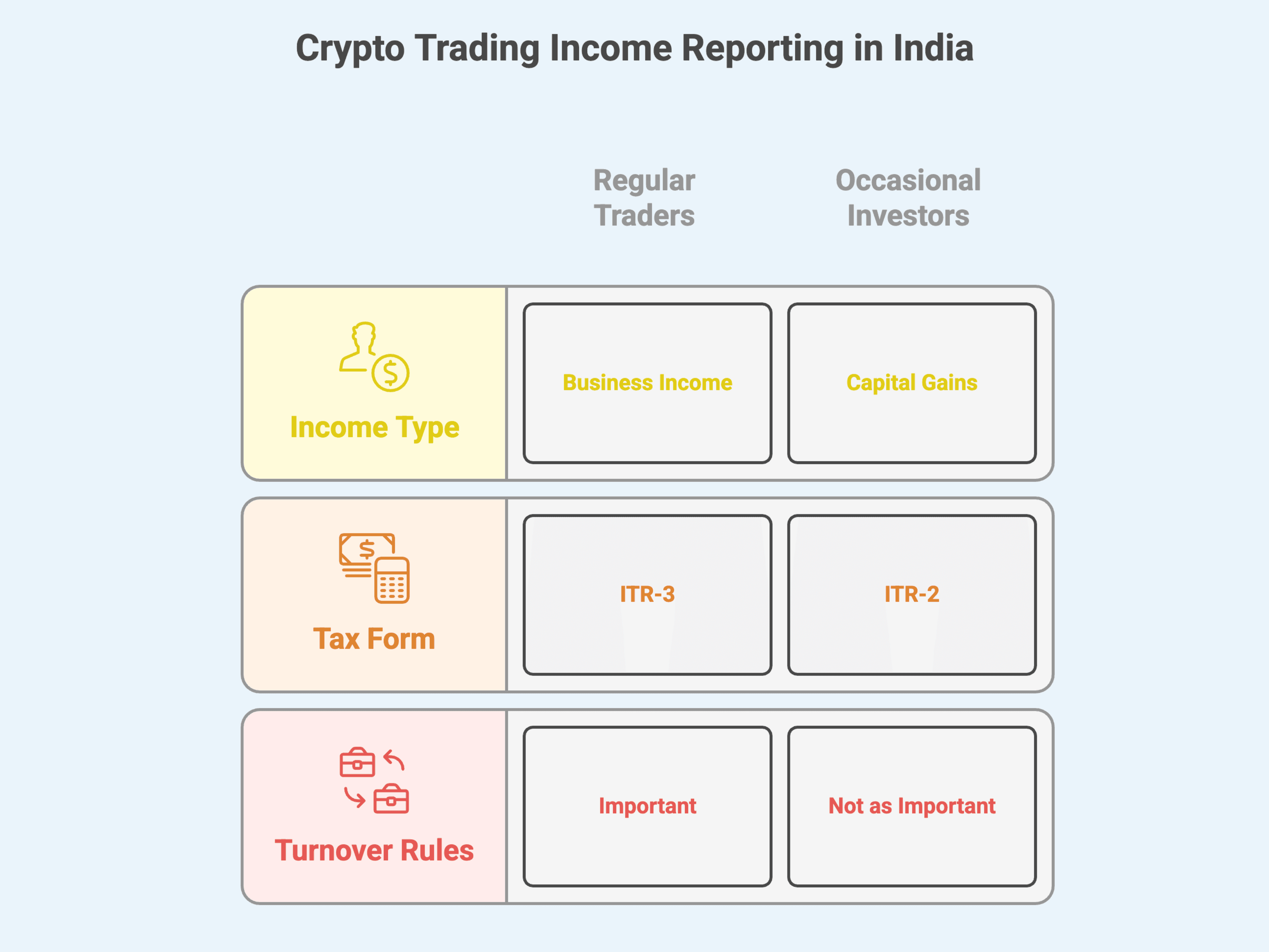
Whether you consider your crypto activity as business income or capital gains, the 30% rate is the same. But classification affects the form you use:
- Regular traders (frequent or professional) often treat crypto as business income (Profit & Gains from Business or Profession). In that case, you’d use ITR-3 to report it. If you treat crypto trading as a business, understanding crypto turnover rules India becomes important, especially for audit applicability.
- Occasional investors may treat crypto as capital gains. You’d still end up with the same 30% on gains, but you’d report under capital gains in ITR-2.
What You Need to Do
As a high-frequency trader, you need to know how to calculate crypto tax for day trading in India. You also need to be very clear about how you handle your crypto taxes. Here's a short list of what you need to do:
1. Keep good records. Keep a record of every crypto transaction, including the date, amount, and price of each buy or sell. You will need these for Schedule VDA. cryptact and other crypto tax software can help you out while still making sure everything is right and accurate.
2. Check the TDS deductions. Check Form 26AS to see if you have received the 1% TDS on each sale. If you traded outside India and didn't pay TDS, you need to pay that 1% yourself.
3. Calculate how much money you made. Add up all the money from sales and subtract the total cost of purchases. You have to pay taxes on that net amount of crypto.
4. If you need to, pay your taxes ahead of time. You may need to pay advance tax on your estimated gains during the year because there is no withholding (other than the 1% TDS). This is especially true if you trade a lot.
5. Put it in the right category and ITR form. If you trade in crypto, use ITR-3 (business income). ITR-2 (capital gains) if it's an investment. In either case, add your crypto information to Schedule VDA.
If you’d like a full, detailed rundown of the crypto tax rules, sections, and filing process in India, check out our guide here.
Final Words
Now that you understand crypto tax for day traders, you know that doing smart work is what really matters. With so many trades and tight reporting rules, crypto audit risk for high-frequency traders India is higher, which is why keeping clean records and using automated tools really helps.
cryptact makes crypto tax calculations easier by automatically keeping track of trades, following India's VDA rules correctly, and making reports that are ready for ITD. When trading gets complicated, having reliable help makes it much easier to stay compliant. Try cryptact today and see for yourself how different it is!