

Fact-checked and reviewed by MetaCounts.co, a Vancouver-based cryptocurrency accounting firm staffed by Chartered Professional Accountants (CPAs).
Crypto tax filing in Canada gets difficult near the deadline for one reason: the work starts long before the return form. You need complete records from every exchange and wallet, clean transfer matching, and accurate CAD values before you can calculate gains or report anything correctly.
This checklist helps you prepare for the April 30, 2026 deadline using a clear filing workflow. It covers the key CRA dates, the crypto activity you need to review, where to report your amounts, and the mistakes that most often lead to penalties, interest, or rushed filings.
Key takeaways
- For most individuals, the crypto tax deadline for Canada in 2026 is April 30, 2026 for filing and payment of 2025 taxes. For Self-employed individuals, it is June 15, 2026, but any tax owing is still due on April 30. These dates apply to 2025 tax year returns filed in 2026.
- CRA treats many crypto actions as dispositions, including crypto-to-crypto trades and spending crypto. Transfers between wallets you own usually do not create a taxable disposition.
- Most investors report capital dispositions through Schedule 3 and line 12700. People with business-style activity may need to report crypto profits as business income on Form T2125.
- CRA charges late-filing penalties when you owe tax and file late, and CRA may charge interest on late payments. CRA’s prescribed interest rate for overdue taxes sits at 7% in both Q1 and Q2 2026. CRA updates prescribed interest rates quarterly, so confirm the current rate if you read this in a later year.
- cryptact helps you collect exchange and wallet data, reconcile transfers, calculate gains and losses, and prepare tax-ready records for CRA reporting.
No credit card required
What is the crypto tax due date Canada filers need to know in 2026
Start with the date, then build your filing plan backward from it. Once you know the CRA filing and payment deadlines, you can decide how much time you need for reconciliation, ACB calculations, and final return review. Aim to finish reconciliations at least two to three weeks before April 30.
The primary deadline for most individuals is straightforward. CRA sets April 30, 2026 as the deadline for most individuals to file the 2025 return and pay taxes owed. CRA also repeats that payment due date on its tax season pages for 2026 filing.
If you or your spouse or common-law partner runs a self-employed business, CRA gives you until June 15, 2026 to file the return. CRA still expects any balance owing by April 30, 2026 if you want to avoid interest.
CRA also announced that online filing for 2025 returns opens on February 23, 2026. That matters because early filing gives you more time to fix crypto reconciliation issues before April 30. CRA’s tax-season update also notes very high service demand, which helps explain why late-season support gets crowded.
What crypto activity you need to report before you file
Your return only works if you first sort your transaction history correctly. Crypto tax filing in Canada depends on how the CRA treats each action, so you need to separate taxable dispositions from internal movements before you calculate anything.
Before you file crypto taxes in Canada, sort your activity into taxable events and non-taxable movements. This step drives everything else, including your gain or loss calculations and the forms you use.
CRA treats crypto dispositions as events with tax implications in many cases, and CRA asks you to report either business income or capital gains and losses from those dispositions.
Common taxable crypto events under CRA rules
CRA says a disposition may happen when you do any of these actions:
- Trade crypto for CAD or another currency
- Trade one crypto asset for another crypto asset
- Use crypto to buy goods or services
- Gift or donate crypto by transferring ownership
CRA lists these examples directly in its crypto guidance. CRA also explains that using crypto to pay for goods or services counts as a barter transaction for income tax purposes. This includes exchanging a crypto-asset for stablecoins or wrapped tokens, even when the swap feels like a simple conversion.
Quick example
You swap ETH for SOL on a centralized exchange and never convert to cash. CRA still treats that swap as a disposition of ETH. You need the CAD value of the ETH you gave up on that date to calculate your gain or loss. CRA’s crypto examples use this same logic for trading one crypto asset for another.
Are internal wallet transfers taxable in Canada
Many people worry about this during reconciliation. CRA says some transactions do not result in a taxable disposition, and CRA gives one clear example: transfers of crypto-assets between wallets that you own.
That point helps, but it also creates a recordkeeping job. You need enough evidence to show CRA that a withdrawal from one platform matches a deposit into your own wallet or another account you control.
Capital gains or business income
CRA does not give one fixed rule for every crypto user. CRA looks at your facts and decides whether your profits look like capital gains or business income on a case-by-case basis. CRA lists factors like trading frequency, short holding periods, time spent, market knowledge, debt financing, and conduct that looks like a trader.
For many retail investors, the main outcome looks like this:
- Capital treatment usually means you report net capital gains and losses on Schedule 3, then include 50% of net capital gains on line 12700.
- Business treatment usually means you report the full business profit or loss.
CRA’s crypto page also states that if the disposition sits on capital account, you include half of the capital gain in income.
April 30 crypto tax filing checklist for Canada
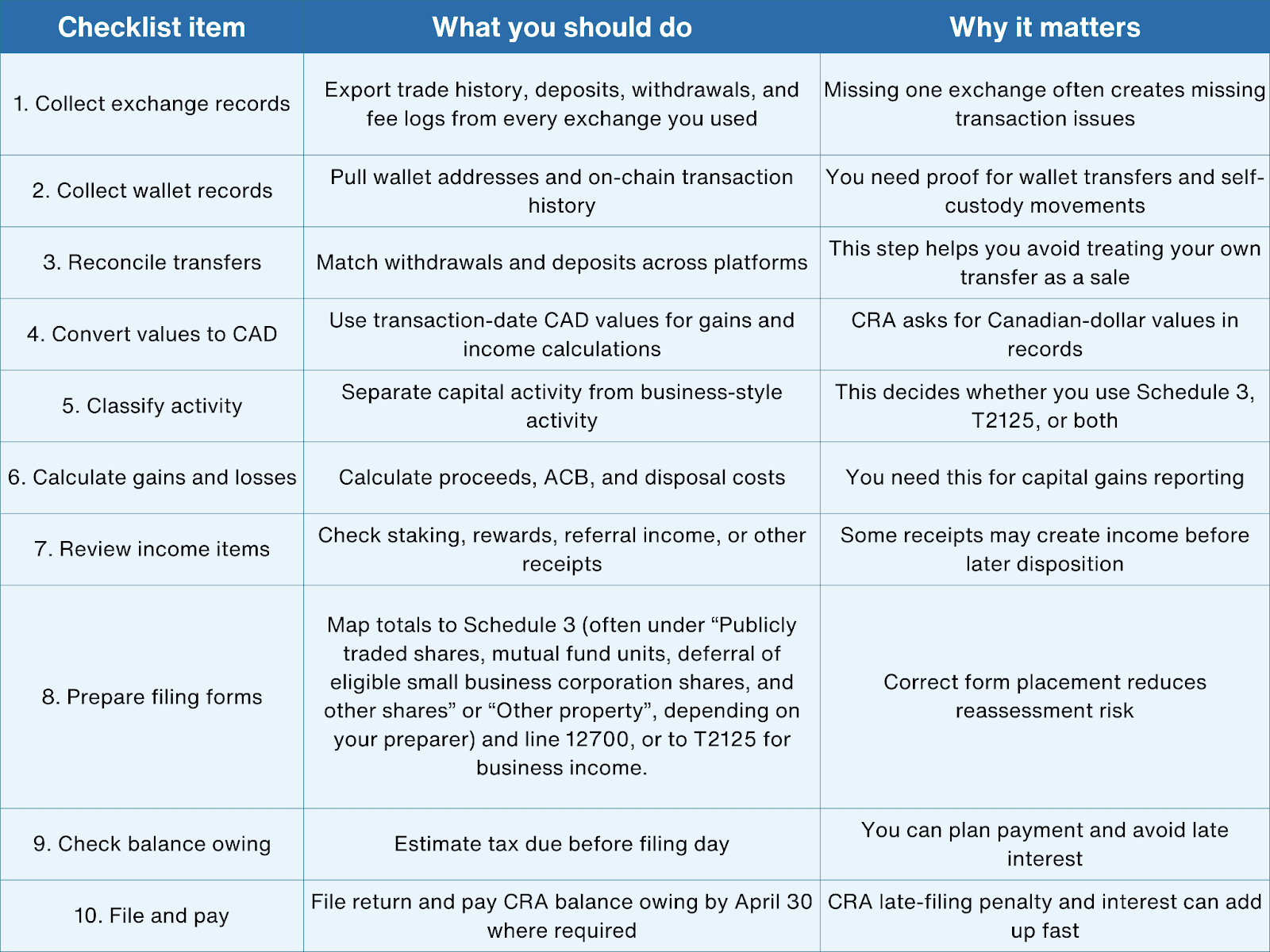
A checklist helps because crypto filing work rarely fails in one big place. Small misses stack up instead, like a missing exchange export, an unmatched wallet transfer, or a CAD value you forgot to record.
This section gives you a practical crypto tax filing checklist for Canada which you can use before the April 30 deadline. Follow it in order and you will cut down most last-minute errors.
Filing checklist table
Crypto tax documents that Canadian filers should keep
CRA tells crypto users to keep adequate books and records for each transaction. CRA lists details like number of units, asset type, date and time, CAD value at the time of each transaction, wallet addresses, and beginning and ending wallet balances by asset for each year. CRA also tells users to keep exchange trade ledgers and transfer ledgers.
CRA encourages electronic records and tells taxpayers to export records regularly because exchanges follow different record standards and you could lose access later. CRA also tells taxpayers to keep required records for at least 6 years from the end of the last taxation year they relate to.
That record list alone explains why many people struggle in April. You often need data from multiple sources, and each source formats exports in a different way.
Where to report crypto on your Canadian tax return
Once you finish the calculations, the next step matters just as much. You need to place the final numbers in the correct part of the return so CRA can read your filing properly.
Once you finish your calculations, you need to place the numbers in the right part of the return. This step answers the common Schedule 3 crypto Canada question and helps you avoid crypto tax reporting errors.
Capital gains reporting for many investors
CRA’s line 12700 guidance says that if you sold or disposed of property in 2025 and your taxable capital gains exceed allowable capital losses, you include the difference on line 12700 of your return. CRA also directs you to Schedule 3 to calculate the amount. CRA’s Schedule 3 page repeats that process.
Example
You bought BTC for CAD 8,000 and later sold it for CAD 11,000. You paid CAD 100 in selling fees. Your capital gain equals proceeds (11,000) minus ACB (8,000) minus selling costs (100), which gives CAD 2,900. If CRA treats the transaction on capital account, you include the taxable portion on line 12700 through Schedule 3. CRA’s capital gains pages use the same calculation structure with proceeds, ACB, and outlays.
Business income reporting when your activity looks like a business
If CRA views your crypto activity as business activity, CRA says you report the full profit or loss from dispositions as business income or loss. CRA’s crypto page points taxpayers to business income guidance, and CRA’s Form T2125 page says you use T2125 to report business or professional income and expenses.
This point matters for active traders, some miners, and people with frequent profit-seeking activity. Your filing path changes when CRA treats the activity as business income.
Mixed activity can happen
To handle this, document your intent for each wallet or account, such as an investment wallet versus a trading wallet, and keep that note with your records.
Some people hold one set of assets for long-term investing and trade another set actively. In real life, your records need to support your classification for each stream of activity. Clean records and consistent notes help a lot if CRA asks questions later.
How to pay CRA balance owing before the deadline
Filing the return and paying the tax do not work as separate tasks at the end of April. A lot of people file on time but still pay late, then get hit with avoidable interest.
CRA’s payments pages list April 30, 2026 as the deadline to pay individual taxes for the 2025 tax year through the tax season guidance pages. CRA also offers several payment methods. CRA payment pages state that you can pay through online banking with most banks and credit unions, and you can also schedule future payments. CRA also offers My Payment for one-time online payments by debit card, not credit card.
Practical payment tips for crypto filers
- Avoid waiting until the final day if you owe a balance.
- Check processing time and confirmation after payment
- Keep proof of payment and your filing confirmation together
- File on time even if cash flow feels tight
CRA’s late-filing penalty page tells taxpayers to file on time even if they cannot pay by the due date, because filing late can trigger a separate penalty when tax is owing.
What happens if you miss the deadline
CRA can charge a penalty for filing late when you owe tax, and CRA can also charge interest when payment arrives after the due date.
A missed deadline can create two separate costs. CRA may charge a late-filing penalty if you owe tax and file late, and CRA may also charge interest on late taxes if you pay late.
Late filing penalty Canada tax rules for 2025 returns filed in 2026
CRA’s personal income tax penalty page lists this late-filing penalty for 2025 returns:
- 5% of your 2025 balance owing
- Plus 1% of your 2025 balance owing for each full month late, up to 12 months
CRA also lists a repeated late-filing penalty with higher rates in some cases if you received a demand to file and CRA penalized you in one of the prior years listed by CRA.
Quick example
You owe CAD 4,000 and file 3 full months late. CRA can charge a late-filing penalty of 5% (CAD 200) plus 3% (CAD 120), for CAD 320, before interest.
CRA interest on late taxes changes by quarter
CRA says it may apply interest when you do not pay an amount due on time, and CRA charges interest on most late personal and business tax payments. CRA also publishes prescribed interest rates by quarter. CRA’s 2026 Q1 and Q2 pages both list 7% as the interest rate charged on overdue taxes. CRA updates these rates quarterly, so check the CRA prescribed interest pages if you pay after the deadline.
How cryptact helps with crypto tax filing Canada
Most crypto filing stress comes from scattered records, not from the CRA form itself. cryptact helps you bring the data together first, which makes the tax calculation and filing steps much easier to manage.
This is where cryptact helps in a practical way:
- It consolidates trades and transfers across exchanges and wallets in one place
- It helps you spot missing records and unmatched transfers before filing day
- It supports gain and loss calculations for Canadian reporting workflows, including ACB-based tracking needs
- It helps you prepare organized tax reports and records you can use for CRA filing and review
- It helps you keep a cleaner audit trail year-round instead of rebuilding everything in April
For people who use multiple exchanges, cryptact saves time on reconciliation first, then supports reporting. That order matters because poor input data leads to inaccurate tax results.
Conclusion
April 30 filing goes much smoother when you treat crypto tax prep as a records project first and a tax form task second. Once you collect exports, reconcile transfers, classify transactions, and calculate gains properly, the actual filing step becomes far more manageable.
If you want to file crypto taxes in Canada with less stress, start early and build a record trail you can defend. cryptact helps by pulling exchange and wallet data together, reconciling transactions, calculating gains and losses under Canadian rules, and generating cleaner tax records for CRA reporting. That gives you a much better shot at filing on time and avoiding preventable penalties.