Fact-checked and reviewed by Kshitij Shah (BitNine), Chartered Accountant.
Are you a crypto investor in India? If yes, then you must be aware that your profits from virtual digital assets (VDAs) are subject to a flat 30% rate under Section 115BBH. On top of that, there’s also a 1% TDS (Tax Deducted at Source) that’s applied to most crypto transactions. This is under Section 194S. And it makes sure that the government keeps track on your trades and gets consistent data.
With these strict rules, it’s critical to file your crypto taxes correctly. But mistakes happen. Maybe you forgot to report crypto gains in India last year or filled out the wrong forms. But don’t worry. The good news is you can correct these errors and revise crypto taxes in India through official processes.
This article explains how to revise crypto taxes in India, fix filing mistakes using revised or updated returns (ITR-U) and avoid penalties or notices from the tax department. Read on to find out more.
Table of contents |
Why Revise Your Crypto Tax Filings?
The Income Tax Department now actively matches data from exchanges and TDS reports to taxpayers’ returns.
If your Income Tax Return (ITR) didn’t include crypto transactions that were reported through TDS or exchange data, expect an alert or email asking you to clarify. Ignoring such issues can lead to heavier penalties.
In fact, under-reporting your income can invite a penalty of 50% of the tax due, and deliberate misreporting can lead to a penalty up to 200% of the tax (plus potential prosecution for willful concealment). In extreme cases, tax authorities have even conducted search and seizure operations.
Given the high stakes, it’s essential to rectify any errors or omissions in your crypto tax reporting promptly. Whether you omitted some crypto trades, used the wrong form, or reported incorrect figures, you should take steps to correct it. This crypto tax rectification in India will not only bring you into compliance but also give you peace of mind.
How to Fix Crypto Tax Filing Mistakes in India
Fixing a crypto tax filing mistake involves updating your ITR to include the correct information. The exact method depends on when you catch the mistake:
Within the same assessment year
If you realize the error before the tax filing deadlines (or shortly after, within the permitted period), you can file a Revised Return under Section 139(5). A revised return simply replaces your original return with corrected details (e.g., adding your crypto gains in Schedule VDA).
This is typically possible up to the end of the relevant assessment year (for example, a mistake in the FY 2024–25 return could be revised by December 31, 2025 for FY 2024-25). There is usually no specific penalty for a timely revised return, though interest may apply on any additional tax due.
After the revision deadline
If the deadline to revise has passed or if you missed reporting crypto gains in an earlier financial year entirely, India’s Income Tax laws provide for an Updated Return (ITR-U) mechanism under Section 139(8A). This allows a taxpayer to update or rectify an older return within 48 months (4 years) from the end of the relevant assessment year, as per the updated ITR-U framework notified by CBDT.
For instance, if you failed to include crypto profits in your FY 2022–23 return (AY 2023–24), you now have until March 31, 2028 to file an updated return for that year, because the ITR-U window now extends to 48 months. The ITR-U lets you declare additional income (such as previously unreported crypto trading gains) and pay the due tax with a prescribed additional penalty.
Filing an Updated Return (ITR-U) for Crypto Gains
Filing an updated return is the official process for crypto tax rectification in India when income was missed earlier. Here is a step-by-step guide on using ITR-U to revise ITR for crypto gains that were omitted:
1. Check Eligibility
- You can file ITR-U within 48 months (4 years) from the end of the relevant assessment year.
- It’s only for adding missed income, not for claiming refunds or changing income types.
2. Log in to the Income Tax Portal
- Go to https://www.incometax.gov.in/iec/foportal/ and log in.
- Navigate to e-File → Income Tax Return → File Updated Return (ITR-U).
- Select the relevant year and reason: “Previously not reported income”.
3. Choose the Correct ITR Form
- Use ITR-2 for capital gains from crypto (if you’re an investor).
- Use ITR-3 if you’re actively trading or mining (i.e., business income).
- Do not use ITR-1, as it doesn’t support crypto reporting.
4. Fill in Crypto Details in Schedule VDA
- Enter acquisition and sale dates, asset type, sale value, cost of acquisition, and exchange/platform used.
- Report all missed transactions, including losses (even if not deductible).
5. Calculate and Pay Tax
- Tax: 30% on gains + surcharge and cess.
- Interest: Under Sections 234B/234C for late payment.
- Additional tax (as per Section 140B):
- 25% of total tax and interest, if ITR-U is filed within 12 months of the end of the AY
- 50% of total tax and interest, if filed after 12 months but before 24 months
- 60% of total tax and interest, if filed after 24 months but before 36 months
- 70% of total tax and interest, if filed after 36 months but before 48 months
- Pay using the generated challan.
6. Submit and Verify
- Submit the ITR-U with supporting ITR form.
- E-verify using Aadhaar OTP, net banking, or other available methods
- Download the acknowledgement for your records.
Through the above steps, you can fix crypto tax filing mistakes in India even for past years. How to update VDA tax filing in India essentially boils down to using the ITR-U form with an accurate Schedule VDA attachment to declare all crypto transactions that were previously omitted.
Penalties for Filing ITR-U (Updated Return)
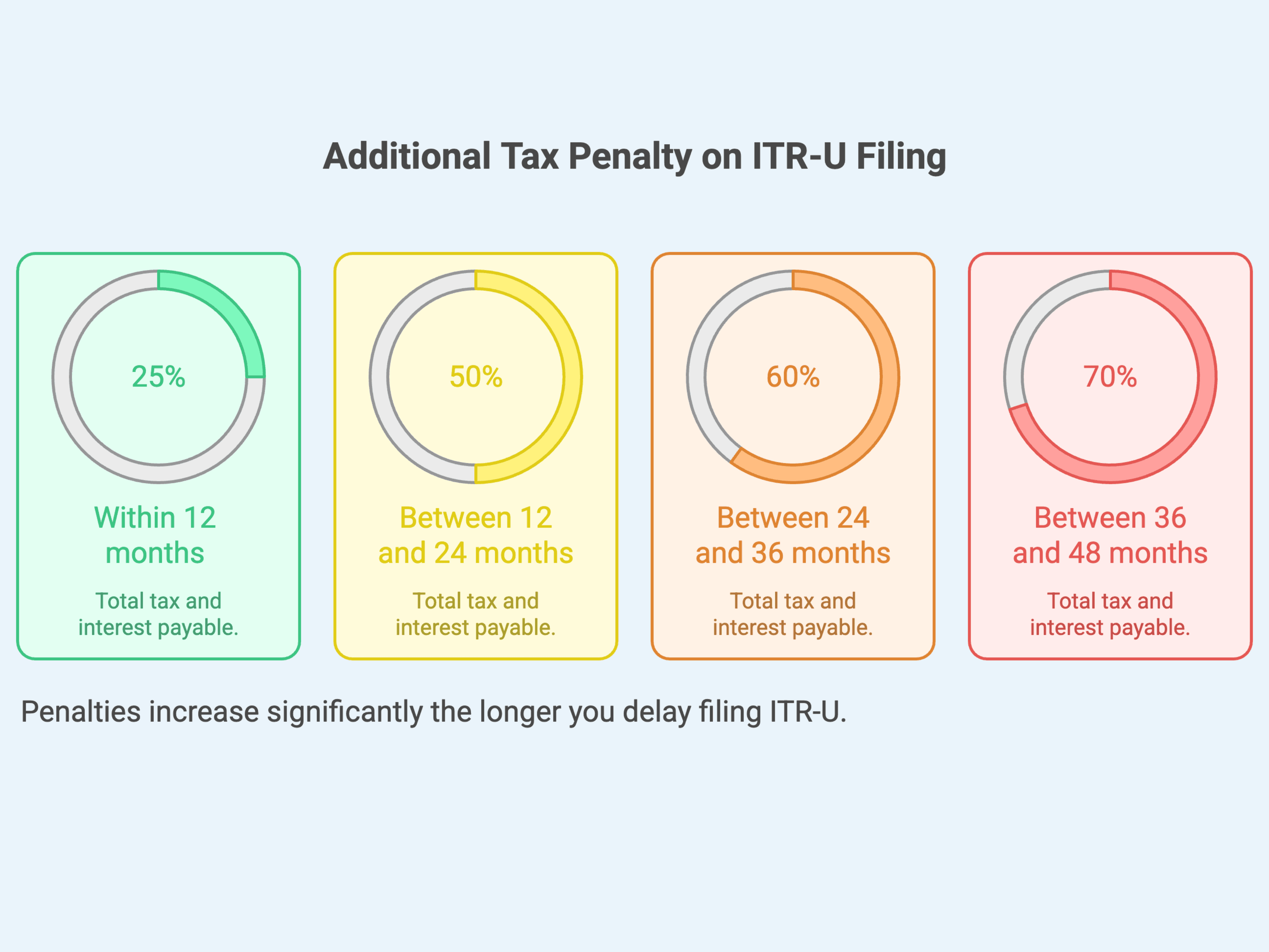
Filing an updated return allows you to come clean voluntarily, but it does come at a cost. There is a penalty fee on the additional tax you owe when using ITR-U, as an incentive for taxpayers to correct mistakes sooner rather than later. The longer you wait, the higher the penalty percentage:
| Time of Filing ITR-U (after AY ends) | Additional Tax Penalty on the due tax + interest |
|---|---|
| Within 12 months | 25% of the total tax and interest payable |
| Between 12 and 24 months | 50% of the total tax and interest payable |
| Between 24 and 36 months | 60% of the total tax and interest payable |
| Between 36 and 48 months | 70% of the total tax and interest payable |
Avoid Penalties and Notices in the Future
To avoid errors going forward, consider using a tool like cryptact. It can automatically sync your trades across exchanges, calculate gains and losses according to Indian tax laws, and generate accurate reports for your ITR, including Schedule VDA. It also helps flag missing data or mismatches early. This way, you reduce the chances of incorrect filings or receiving a crypto tax notice later.
Conclusion
Staying compliant with crypto taxes might seem daunting. But it’s absolutely manageable with the right approach. If you discover an error or omission in your filing, leverage the revision tools (a timely revised return or the ITR-U updated return) to make things right.
In summary, whether it’s a small oversight or a major unreported gain, how to fix crypto tax filing in India comes down to acknowledging the mistake and using the available mechanisms to correct it. Correcting past returns and adhering to best practices going forward, you can invest in crypto with confidence that your tax matters are in order.
Ultimately, that peace of mind is worth the effort it takes to revise and update your crypto tax returns in India. If you want to stay accurate and stress-free during crypto tax season, start organizing your trades with cryptact today.