
Fact-checked and reviewed by MetaCounts.co, a Vancouver-based cryptocurrency accounting firm staffed by Chartered Professional Accountants (CPAs)
The Crypto Asset Reporting Framework (CARF) is the new global standard for tax reporting on crypto assets. It comes from the OECD and extends the automatic information exchange that already exists for bank and investment accounts under the Common Reporting Standard.
Under carf crypto rules, many exchanges and other platforms will have to collect tax data on their users and send it to tax authorities, who then share it with each other. There is no new tax. Instead, tax offices get a clearer view of what people do with crypto across borders.
For Canadian traders, this means CRA will start receiving structured data from local and foreign exchanges. This article explains what CARF is, when it starts to matter for Canada, what will be reported, and how to prepare without getting lost in technical detail.
Table of contents |
No credit card required
What the Crypto Asset Reporting Framework is
CARF is an OECD standard for automatic exchange of information on crypto assets for tax purposes. The aim is to stop people from hiding gains by using offshore exchanges or wallets in other countries.
In simple terms, what is CARF crypto reporting:
- It applies to Crypto Asset Service Providers (CASPs) such as exchanges and brokers
- These providers must identify customers, confirm tax residency and collect tax numbers
- They must send yearly reports of relevant crypto transactions to their own tax authority
- Tax authorities then exchange that data with other countries under agreements
The OECD CARF crypto documents say reporting covers three main types of activity:
- Crypto-to-fiat trades
- Crypto-to-crypto trades
- Certain transfers, including transfers to self-custody, above set thresholds
CARF does not change how Canada taxes crypto. CRA already treats crypto as property, with gains as either business income or capital gains. CARF changes how easily CRA can see what you have done on exchanges.
Global timeline and Canada’s plan
CARF starts at different times in different places. Countries must pass their own rules that follow the OECD standard.
The OECD notes that the first exchanges of CARF data between tax authorities are expected to begin in 2027, for data collected from 2026. In practice, this means many exchanges in early adopter countries start gathering CARF grade data from 1 January 2026.
Canada has already joined the international commitment. A 2023 statement from the Department of Finance confirmed that Canada intends to implement CARF and join the automatic exchange system.
Later commentary on Canadian draft rules and CRS 2.0 shows the current plan:
- CARF-style reporting will apply to Canadian resident crypto asset service providers
- The rules are tied to the 2026 calendar year
- First exchanges of CARF and updated CRS data involving Canada are expected around 2027
So when people talk about CARF canada crypto, the key idea is that from the year 2026 onward, Canadian and foreign exchanges will move toward a world where the CRA receives automatic crypto data, similar to how it already receives bank account data under CRS.
What exchanges will report under CARF
CARF focuses on reporting crypto asset service providers, not on private individuals. A provider is in scope if it runs a business that carries out exchange or transfer services in covered crypto assets.
Under carf reporting crypto rules, platforms that serve Canadian residents will record and send structured data like this:
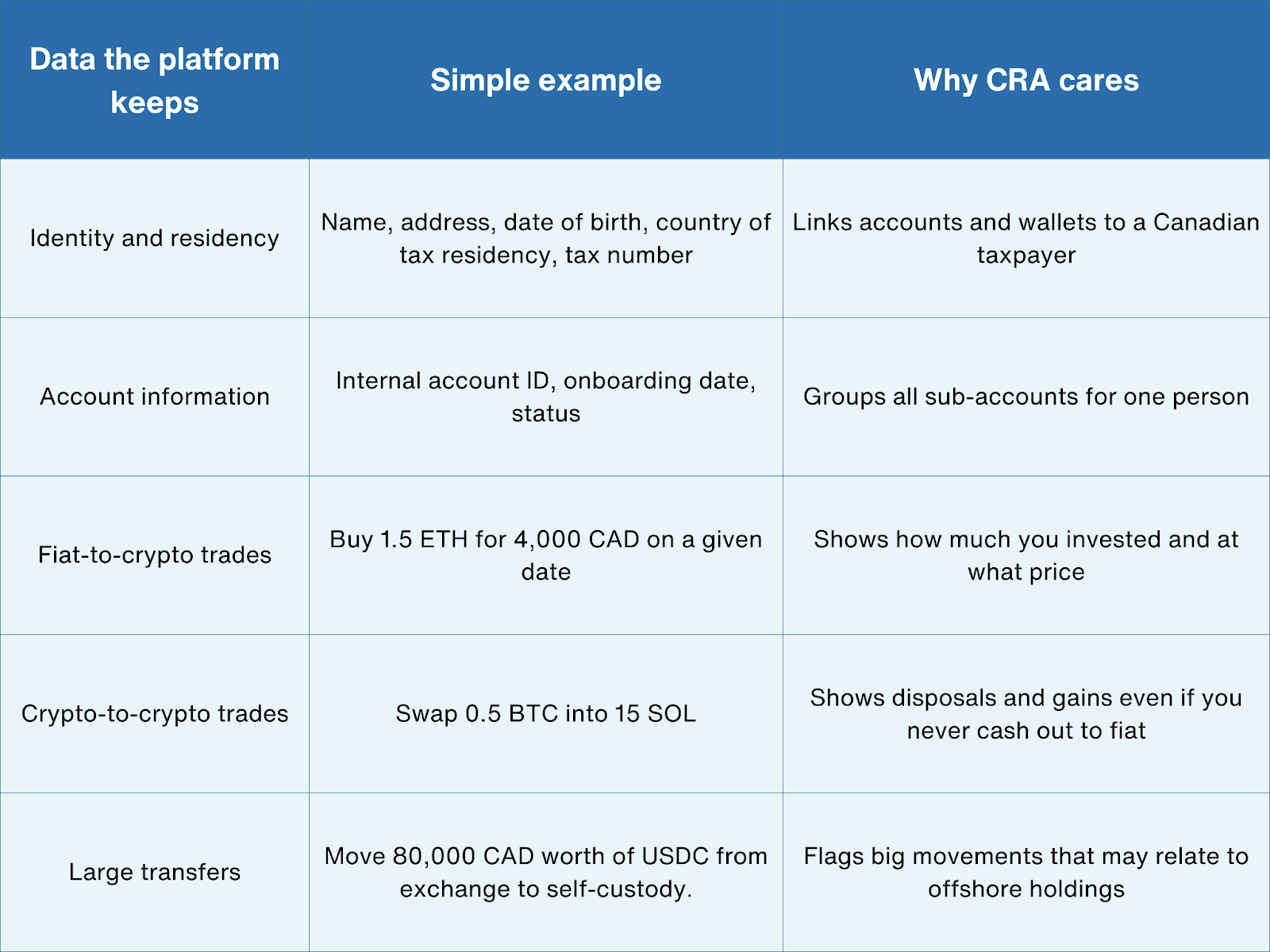
This is the core of CARF crypto reporting rules. Instead of the CRA having to ask an exchange for data in an audit, the exchange sends a standard file each year. That file then moves between tax authorities when they share data.
What this means for Canadian crypto investors
CARF changes the risk of not reporting more than it changes the tax bill itself.
Canadian exchanges
Once Canada’s rules are active, Canadian exchanges and brokers that qualify as service providers will:
- Ask you to confirm tax residency and provide your tax number
- Tag you as a Canadian resident in their systems
- Include your trades and large transfers in yearly CARF reports that go to CRA
You do not file these reports. The platform does.
Foreign exchanges
Many Canadians also trade on large foreign platforms. If those platforms sit in CARF countries and you show as Canadian in their KYC data, they will report on you to their own tax office, which will then send that part of the file to CRA.
So how carf affects canadian crypto investors is simple:
- CRA gets a much clearer view of where you trade and how much you move
- It becomes harder to leave whole accounts out of your Canadian tax return
- Past years that you never reported may stand out once automatic data starts to flow
How to prepare before reporting starts
CARF does not add new Canadian taxes. It makes poor record keeping and silent non reporting much more visible. You do not need a complex plan. You need a clean one.
Steps that help most traders:
- Make a full list of platforms
Include all Canadian and foreign exchanges, brokers and structured products you use or used. - Download complete histories now
Export full CSV files: trades, deposits, withdrawals and fees. It is easier to do this before platforms change formats or merge. - Bring your tax returns in line with reality
If you have years of trading with no mention of crypto in your returns, discuss a voluntary disclosure filing with a Canadian tax adviser before CARF reports build up. - Answer self-certification questions carefully
When an exchange asks for your tax residency and number under CARF, give correct and consistent information. - Keep your future setup simple
A smaller number of well-run platforms is easier to track and reconcile than many small accounts scattered across the world.
These moves do not remove tax. They make sure CARF data and your own filings tell the same story.
How cryptact fits into a CARF
CARF will send more data to CRA. It will not tidy your personal records. You still need a way to see your own activity clearly.
This is where cryptact helps. cryptact is a crypto tax and portfolio tool that already supports Canadian capital gains rules. Public material from the company notes that it handles adjusted cost base and supports Canadian reporting formats.
For a Canadian investor facing CARF, cryptact can:
- Pull in CSV or API data from multiple exchanges and wallets
- Apply a consistent adjusted cost base method in Canadian dollars
- Produce gains and losses that you can compare with what exchanges are likely to report under CARF
CARF does not read your cryptact account. It reads data from exchanges. cryptact gives you a single, organized view of the same activity so you can file accurate returns and fix gaps early.
If you treat 2026 and the following years as a cleanup phase: align past returns, standardize records, and use a tool like cryptact—then CARF becomes one more reporting system you are ready for, rather than a surprise when CRA starts matching your return against exchange data.